The Supersonic Airliner — Engineering at Twice the Speed of Sound
What it took to make Concorde carry passengers at Mach 2, from shock waves, delta-wing aerodynamics and supersonic intakes to aerodynamic heating, fuel-based trim and the sonic boom — and why building a successful supersonic airliner remains such a difficult systems-engineering problem.
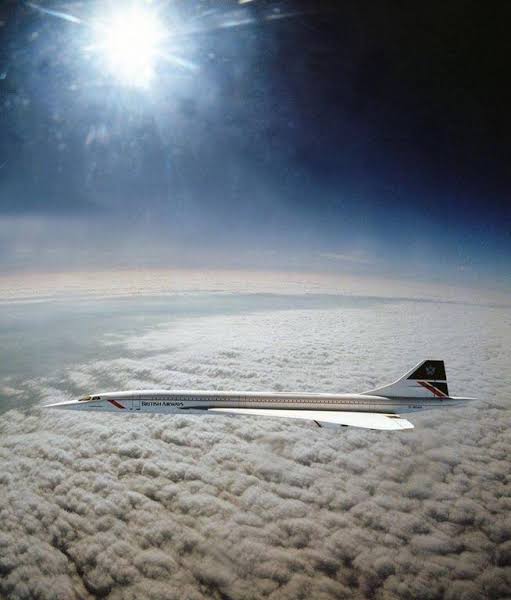
37
minutes
7,325
words approx.
7
indexed topics
09 SEPT
2026
The Supersonic Airliner — Engineering at Twice the Speed of Sound
The 26^th^ of September 1973 dawned much like any other Wednesday. Millions of people got up, drank their morning coffee, went to work and carried on with their lives, accustomed to the familiar pace of the world around them. For a business traveller flying from the United States to Paris, crossing the Atlantic still consumed a substantial part of the day.
But then an aircraft left Washington, DC. Three hours and thirty-three minutes later, it was in Paris. [1]
It had crossed the Atlantic faster than any passenger aircraft before it, travelling for much of the journey at around twice the speed of sound. Perhaps the strangest part was not that such a machine existed, but that within only a few years ordinary airline passengers would be buying tickets to fly on it. [1]
More than half a century later, every scheduled passenger airliner in service is slower.
So what did it actually take to build a supersonic airliner — and why have we never really done it again?
The Race Beyond Mach 1
Supersonic flight went from a poorly understood engineering crisis to a practical reality between the late 1930s and the 1960s. The journey began before and during the Second World War, when increasingly powerful piston fighters such as the Lockheed P-38 Lightning began experiencing violent buffeting, loss of control authority and dangerous nose-down pitching during high-speed dives. Although the aircraft themselves remained below Mach 1, local airflow over parts of their wings could accelerate beyond the speed of sound before abruptly decelerating through shock waves. Pilots had unexpectedly entered what became known as the compressibility crisis. [2][3]
That distinction between aircraft speed and local airflow speed is important. Air flowing over a curved wing is accelerated and decelerated by pressure gradients. An aeroplane travelling at Mach 0.75 can therefore have pockets of airflow over its wing that are already locally supersonic. When those pockets are forced back to subsonic speed, they can terminate in a shock wave: an extremely thin region in which pressure, temperature and density change abruptly. The result can be a sudden rise in drag and a major shift in the forces acting on the wing and tail. [3]
As fighters penetrated further into this transonic regime, these effects stopped being obscure edge cases and became a hard barrier to faster aircraft. Propellers encountered their own version of the problem. A propeller blade has both the forward velocity of the aeroplane and a rotational velocity that increases towards its tip, so the outer part of the blade can encounter supersonic flow long before the aircraft itself reaches Mach 1. Shock formation then brings severe noise, vibration and aerodynamic losses. [3]
The Republic XF-84H Thunderscreech demonstrated this rather spectacularly. Its supersonic propeller tips produced an extraordinary acoustic environment despite the aircraft itself remaining firmly subsonic. It was not a practical route to a supersonic airliner; instead, it illustrated why exposed propellers become increasingly unattractive as flight speed rises. [4]
Fortunately, two propulsion technologies capable of escaping this limitation were maturing at almost exactly the right time: the turbojet and the liquid-fuelled rocket. Propulsion, however, was only part of the problem. Engineers also had to preserve control as shock waves moved across the aircraft and conventional elevators lost effectiveness. British work on the Miles M.52 during the 1940s incorporated an all-moving horizontal tail, allowing the entire tailplane rather than a hinged elevator alone to control pitch — a configuration that would become fundamental to many later transonic and supersonic aircraft. [2]
Researchers were also converging on another crucial idea: wing sweep. Sweeping a wing rearwards reduces the component of the freestream velocity normal to its leading edge, delaying some of the compressibility effects experienced by an equivalent straight wing. Combined with new propulsion systems, better wind tunnels and a rapidly improving understanding of compressible flow, the basic ingredients for controlled supersonic flight were falling into place. [3]
On the 14^th^ of October 1947, Chuck Yeager piloted the rocket-powered Bell X-1 through Mach 1. The sound barrier had turned out not to be an impenetrable physical wall, but a different aerodynamic regime that could be engineered around.
Breaking Mach 1 in a small research aircraft was still a world away from carrying passengers across an ocean. The decade following Yeager's flight saw jet-powered aviation mature at extraordinary speed. The de Havilland Comet, Boeing 707 and their contemporaries demonstrated that civil aviation could routinely operate high in the atmosphere at speeds that would have seemed remarkable only a decade earlier. [2][5]
At the same time, military aviation pushed deeper into the supersonic regime. Early fighters demonstrated that operational aircraft could exceed Mach 1, but many could sustain their highest speeds only briefly while consuming enormous quantities of fuel. The next step was designing an aircraft around sustained supersonic cruise. Machines such as the Convair B-58 Hustler, followed by the Lockheed A-12 and SR-71 programmes, showed that flight at Mach 2 and beyond could be maintained rather than merely touched. Doing so introduced an entirely new collection of aerodynamic, structural, propulsion and thermal problems. [5]
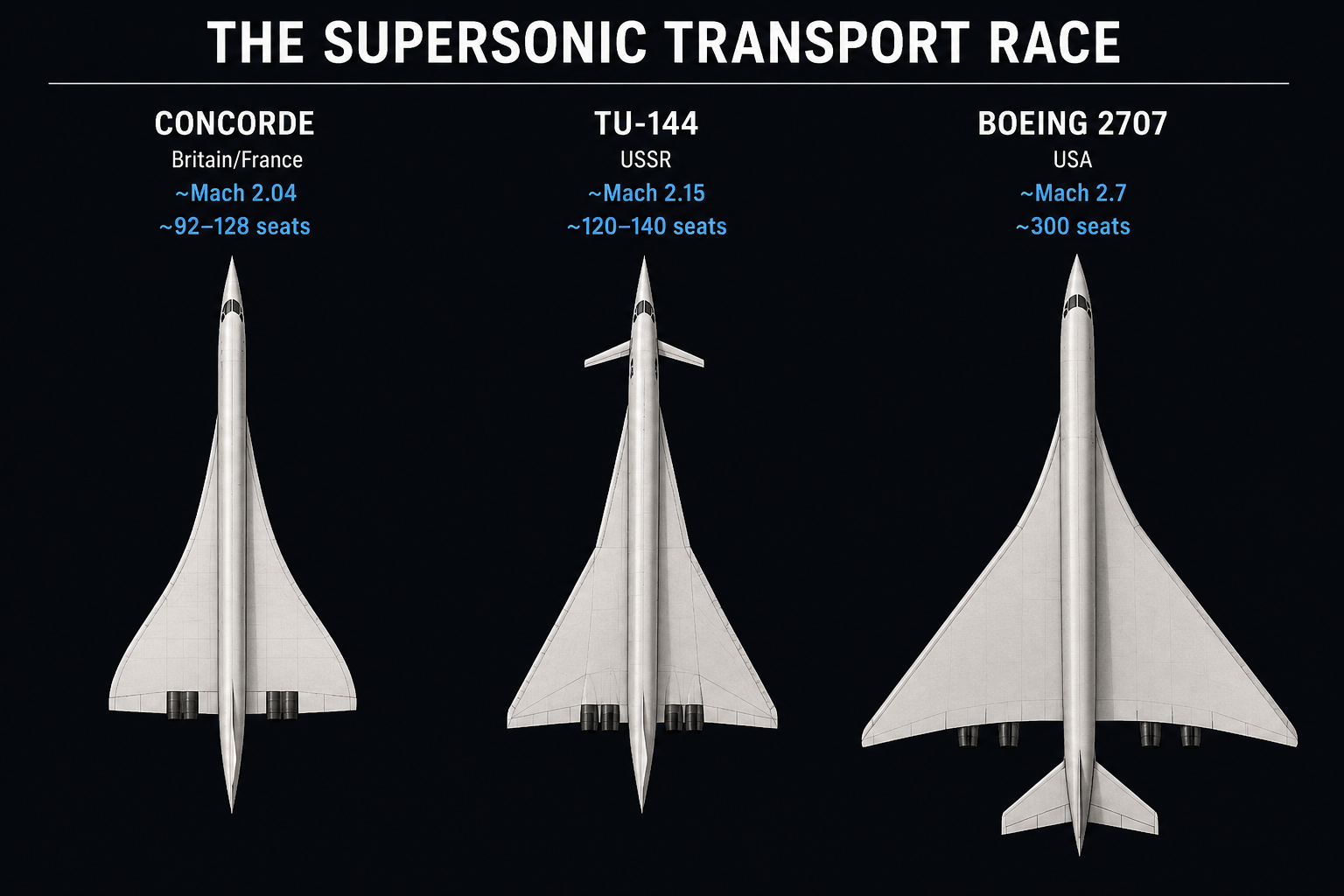
Turning that capability into a commercial supersonic transport (SST) meant combining three previously separate achievements: the reliability and safety of passenger jet travel, the aerodynamics required to pass through Mach 1, and the endurance required to remain near Mach 2 for hours. The challenge triggered a three-way Cold War race between Western Europe, the Soviet Union and the United States. [5]
The Anglo-French programme produced Concorde: roughly 100 passengers, an exceptionally slender ogival delta wing and a design centred on efficient cruise at about Mach 2. The Soviet Union answered with the Tupolev Tu-144. It became the first SST to fly, in December 1968, and the first to exceed Mach 2. Early variants suffered severe range, fuel-consumption and cabin-noise penalties; later aircraft adopted different engines and distinctive retractable ‘moustache’ foreplanes to improve low-speed handling. [5]
Across the Atlantic, the United States aimed considerably higher. Boeing's 2707 was conceived as an enormous transport carrying roughly 300 passengers at around Mach 2.7. Early versions used variable-sweep wings in an attempt to combine efficient supersonic cruise with acceptable low-speed handling. The mechanism required to move such large wings imposed a crippling mass penalty, and the design eventually shifted to a fixed delta. By then, escalating cost, technical complexity, environmental concern and collapsing political support had caught up with the programme. Federal funding ended in 1971 before a prototype flew. [5]
Australia was not entirely outside this story. In 1972 the British prototype Concorde G-BSST visited Australia as part of a promotional and evaluation tour, including work intended to help Australian authorities assess noise and sonic-boom effects. It was an early hint that the SST's future would depend not only on whether engineers could make the aircraft work, but on whether countries underneath its flight paths would accept what supersonic flight brought with it. [6]
By the beginning of the 1970s, however, the fundamental technical question appeared to have been answered. Aircraft could cross Mach 1 safely. They could sustain flight at twice the speed of sound. Commercial jets had proved that passengers could routinely cross oceans at high altitude. Concorde brought those achievements together into one machine. [5]
The supersonic airliner was no longer theoretical.
But making an aircraft fly at Mach 2 was only the beginning. Making one carry passengers efficiently, safely and repeatedly at Mach 2 meant confronting a regime in which almost every familiar assumption about how an airliner should work began to change.
Why Supersonic Flight Changes Everything
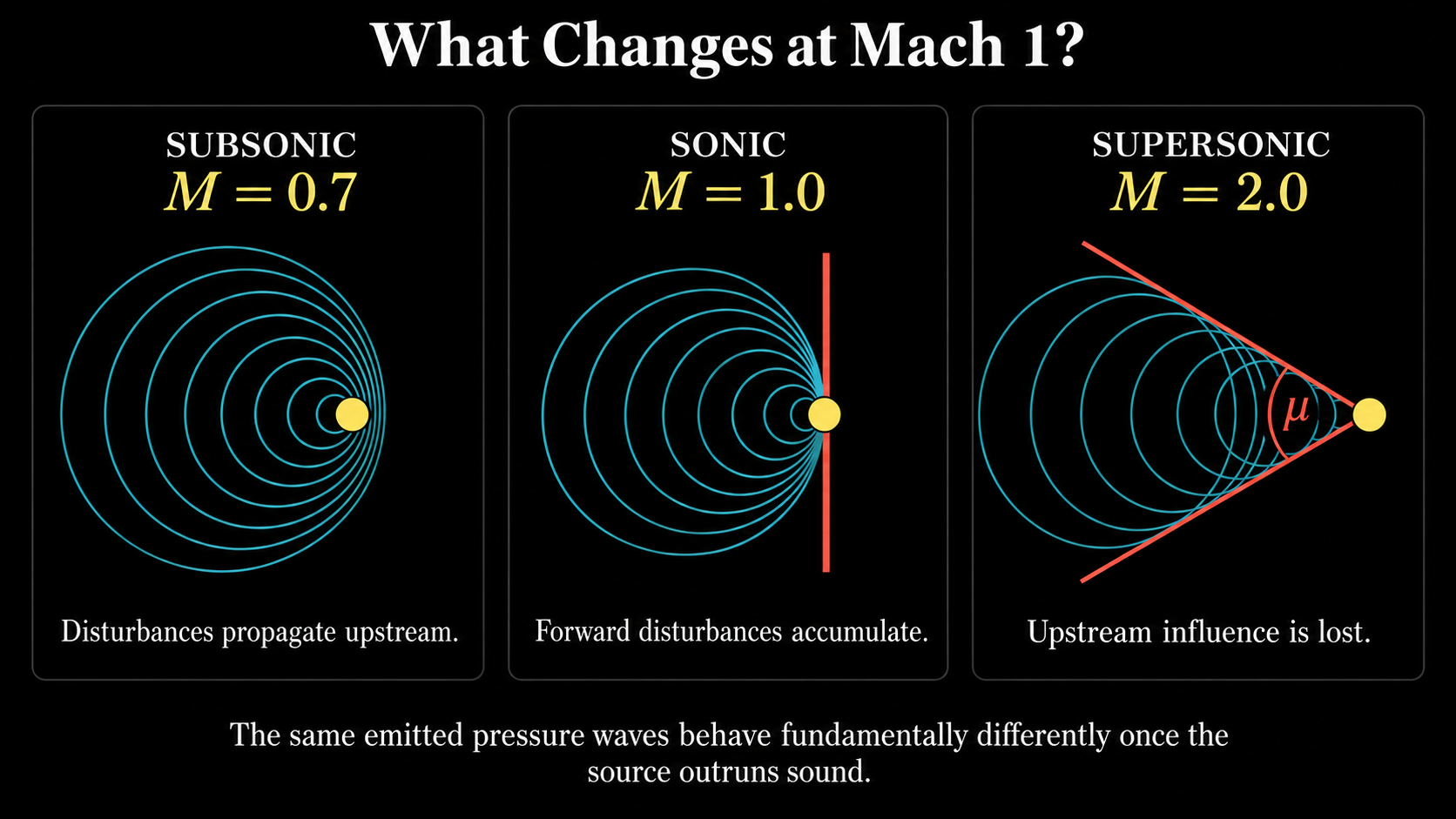
To understand why Concorde became such an unusual aircraft, it helps to begin with something deceptively simple: sound is not an object travelling through the air. Instead, it is a shifting wave of pressure propagating through the atmosphere.
When an aircraft moves at ordinary subsonic speeds, every small pressure disturbance it creates spreads away at the local speed of sound. Some of those disturbances travel forwards, reaching the air before the aircraft does. In a loose but useful sense, the airflow is given advance warning. Pressure can adjust progressively, streamlines can bend around the body, and the influence of the aircraft can manifest upstream.
Interestingly the speed of sound is not fixed. For an ideal gas it is given by [3]
where is the ratio of specific heats, is the specific gas constant and is the absolute temperature. This is why the Mach number is more useful than simply quoting kilometres per hour:
For a given true airspeed, the corresponding Mach number can be different depending on atmospheric temperature. At Concorde's cruise altitude, the air is much colder than at sea level and the local speed of sound is correspondingly lower.
Imagine an aircraft repeatedly emitting small spherical pressure waves as it travels forwards. At Mach 0.7, each new wave begins inside the previous one and the older waves have plenty of time to expand ahead of the aircraft. As the aircraft approaches Mach 1, it begins to catch its own waves. At Mach 1, the aircraft and the forward-moving part of each disturbance travel at the same speed. The pressure disturbances begin to pile up. [3]
Once the aircraft exceeds Mach 1, it outruns them. The old spherical wavefronts are left behind, and their common envelope forms a cone. The aircraft now flies at the tip of a disturbance field that cannot propagate forwards through the surrounding air quickly enough to warn it of the aircraft's arrival.
MATHS INSET — Outrunning Your Own Pressure Waves
If a source moves at velocity , a disturbance emitted at an earlier time expands at the local speed of sound . At observation time , that wavefront occupies a sphere:
The envelope of all those spheres forms the Mach cone. From its geometry,
and therefore
At Concorde's cruise condition of ,
What this tells us: at Mach 2, Concorde had completely outrun the pressure disturbances it produced. The aerodynamic information generated by the aircraft was confined behind it within a relatively narrow cone.
The cone itself is only the beginning. Real aeroplanes are not infinitesimal points. Their noses, wings, engine intakes and control surfaces all force air to change direction, and supersonic air cannot always make those changes smoothly.
Compression becomes a shock
If supersonic flow is turned into itself — for example by a wedge or compression ramp — the required pressure increase cannot communicate smoothly upstream. Instead, many tiny compression disturbances coalesce into a shock wave.
A shock is extraordinarily thin compared with an aircraft, but across it the state of the gas changes abruptly. Static pressure rises. Temperature rises. Density rises. Velocity falls. Most importantly, the process is irreversible: entropy increases and stagnation pressure is lost.
A normal shock sits perpendicular to the incoming flow and produces the strongest possible compression for a given upstream Mach number. The flow downstream becomes subsonic. An oblique shock sits at an angle to the flow. Only the velocity component normal to the shock undergoes the equivalent normal-shock process, so the overall downstream flow can remain supersonic even though it has been compressed and turned.
This is why the exact shape of a supersonic aircraft matters so much. A small change in surface angle can change the location and strength of a shock, which changes pressure, heating and drag over a large part of the aircraft.
MATHS INSET — How Far Can Supersonic Air Be Turned?
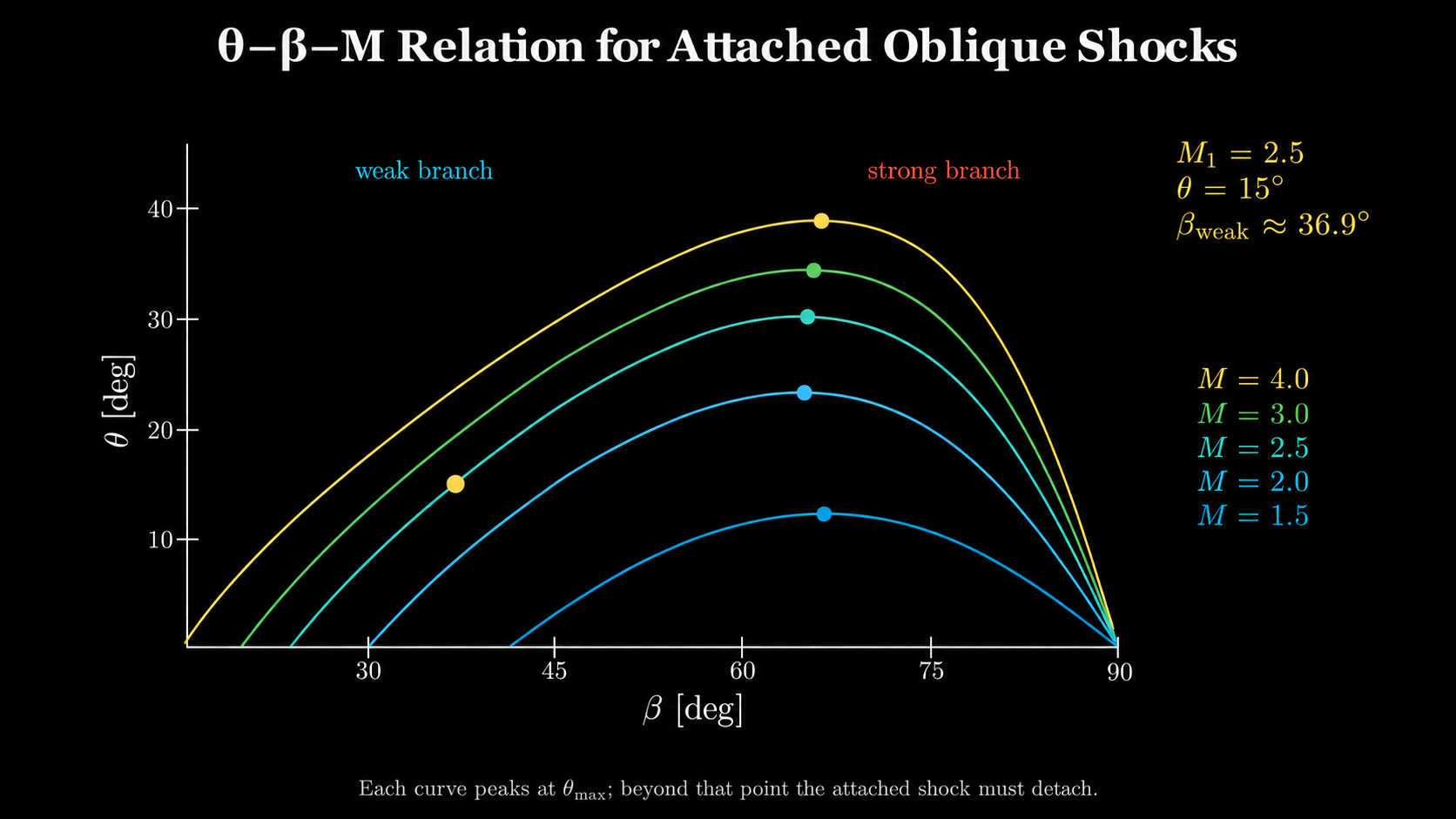
An attached oblique shock cannot form at an arbitrary angle. For a perfect gas, the incoming Mach number , flow-deflection angle , shock angle and ratio of specific heats are related by
For air, . The strength of the shock is governed by the normal Mach component,
For each Mach number there is also a maximum possible attached turning angle,
Try to turn the flow more aggressively and an attached solution no longer exists; the shock detaches and moves ahead of the surface.
What this tells us: there is a mathematical limit to how aggressively a designer can turn supersonic airflow while retaining a relatively efficient attached shock. Slender shapes are not merely an aesthetic choice.
Expansion is different
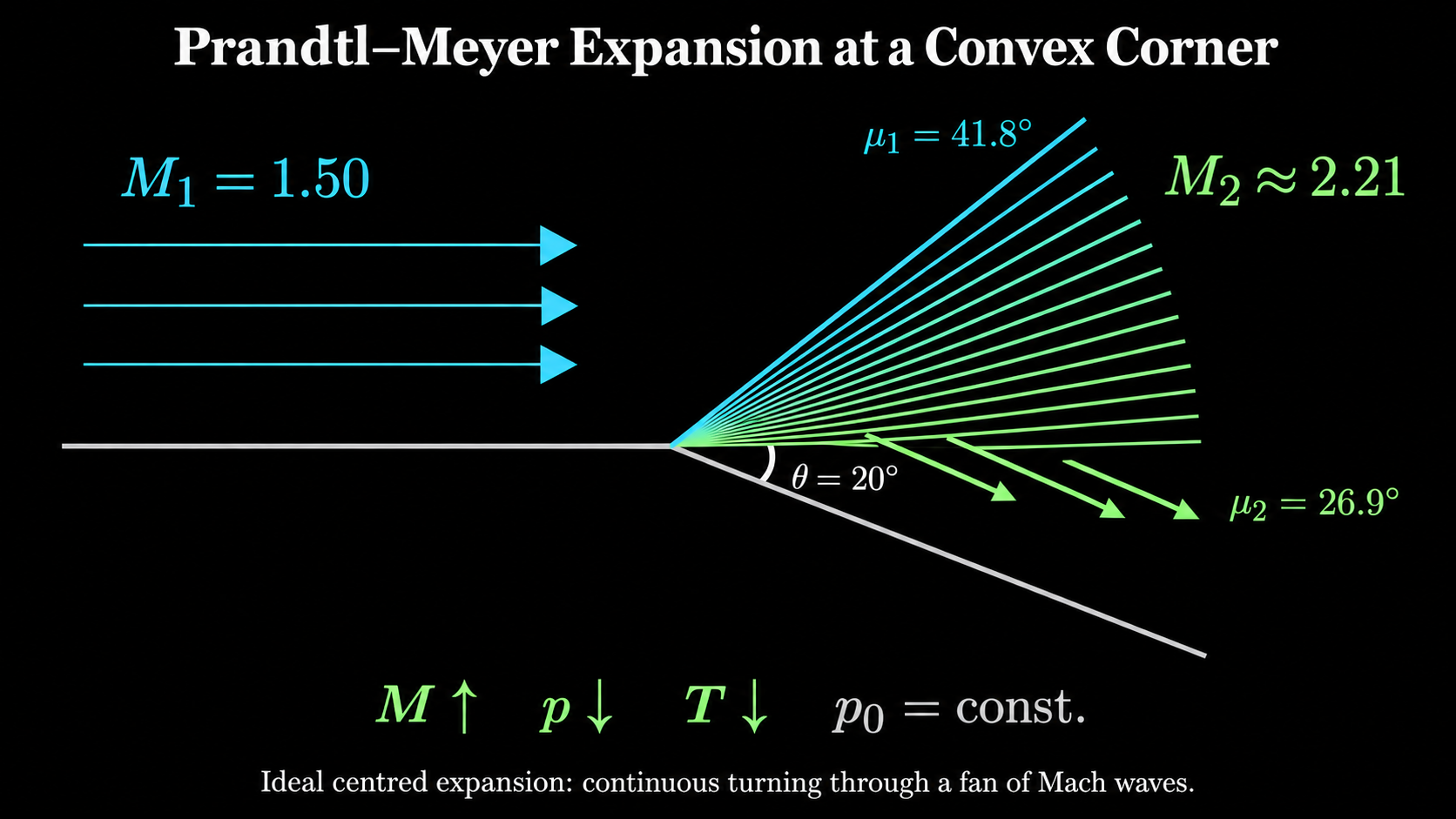
Turning supersonic flow the other way produces almost the opposite behaviour. At a convex corner the air expands through a Prandtl–Meyer expansion fan: a spread of very weak waves rather than one abrupt shock. The flow turns and accelerates while its static pressure and temperature fall. In the ideal model the process is isentropic, so it does not carry the same stagnation-pressure penalty as a shock.
A supersonic aircraft is therefore surrounded by a structured pattern of compression and expansion. The nose generates compression. The wing leading edges create their own wave systems. The engine intakes deliberately manufacture shocks. Convex changes in shape generate expansion fans. These waves then interact with one another and with the boundary layer growing over the aircraft's skin.
The result is wave drag: drag associated with the pressure field and shock system created by compressible flow. A shape that looks beautifully streamlined at low speed can be disastrous at Mach 2 if it creates abrupt cross-sectional changes or strong shocks. Supersonic design therefore rewards slenderness, gradual changes in area and careful management of every surface that turns the air.
This also explains why the transition through roughly Mach 0.8 to Mach 1.2 is such an awkward region. Different parts of the aircraft can be subsonic and supersonic at the same time. Shock waves appear, move and strengthen as Mach number changes. The centre of pressure shifts. Drag rises sharply. Engine intakes must transition from ordinary ducts into shock-controlling devices. The aeroplane is moving between two different aerodynamic worlds rather than simply accelerating through another number on the airspeed indicator.
At Mach 2 these phenomena are no longer temporary transonic nuisances. They are the normal operating environment. Concorde had to live inside that environment for hours while remaining stable, controllable, pressurised, cool enough to inhabit and efficient enough to cross an ocean. [3, 5]
That is the central engineering problem of the SST: supersonic flight is not just subsonic flight performed faster. The governing relationships change strongly enough that the aircraft becomes a different kind of machine. [3][5]
Designing an Airliner for Mach 2
A military interceptor or reconnaissance aircraft can accept high fuel burn, limited endurance, a cramped cockpit and demanding operating procedures in exchange for extreme performance. A commercial SST cannot. It has to cruise for hours at high Mach number, carry a useful payload, meet civil safety requirements, operate repeatedly rather than occasionally, and deliver passengers who reasonably expect the experience to resemble an airline flight.
That requirement set forces a cascade of compromises. The wing must be thin and highly swept for efficient supersonic cruise, yet still produce enough lift to take off and land. The propulsion system must provide enormous thrust for take-off and transonic acceleration, yet avoid burning fuel in reheat throughout cruise. The structure must be light enough to fly economically but tolerate repeated heating and cooling. The cabin must remain pressurised and comfortable while the skin outside becomes hot enough to cook food. The aircraft's balance must be actively managed as its aerodynamic centre moves with Mach number.
Concorde's achievement was not that it solved any one of these problems in isolation. It was that all of them were made to work together in an aircraft that could enter scheduled airline service.
The Wing — One Shape, Two Completely Different Jobs
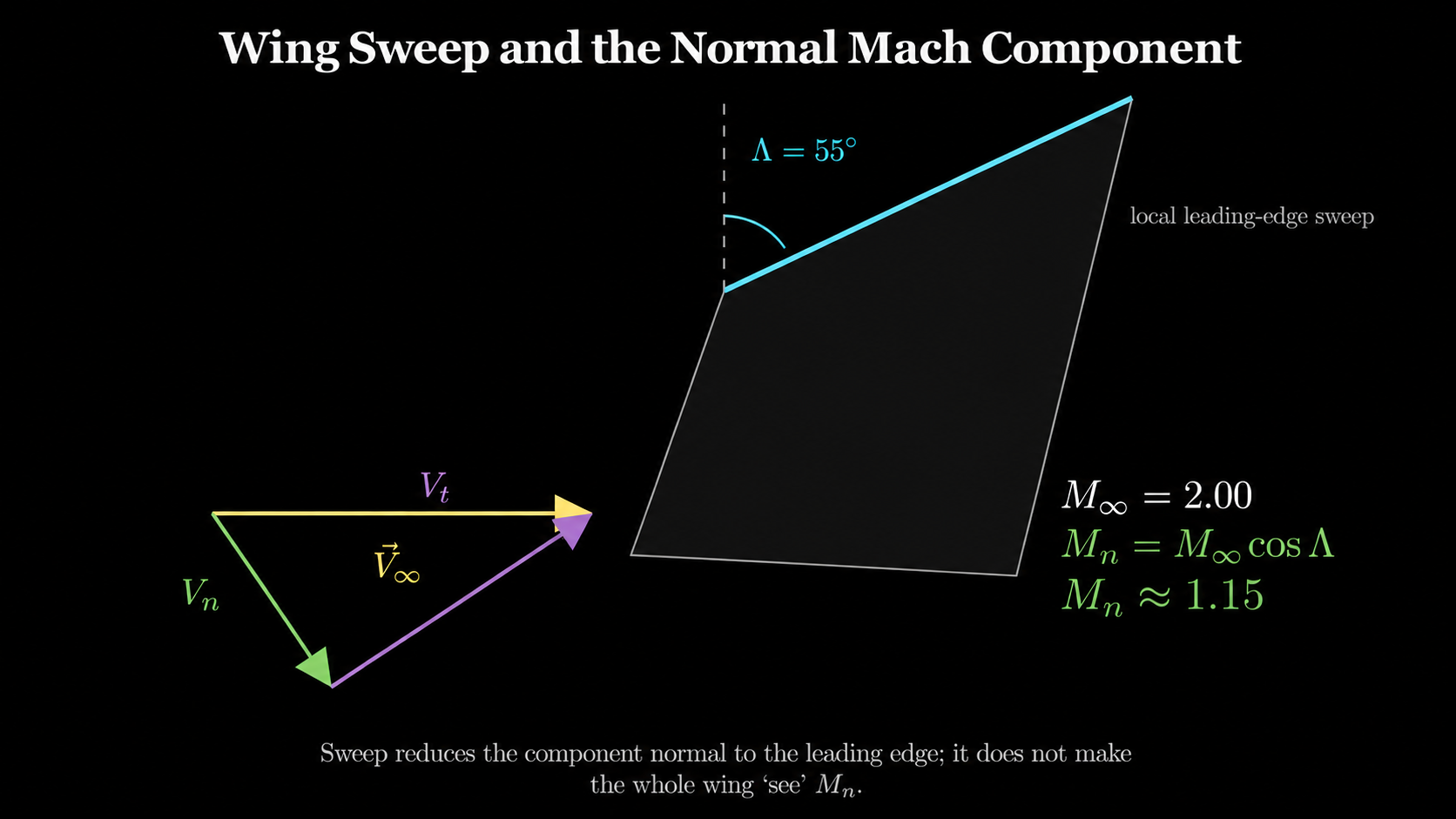
Concorde's most recognisable feature is its ogival delta wing: a thin, curved delta planform whose sweep changes along the leading edge. The geometry grew from extensive British and French research into slender wings during the 1950s and 1960s. [5]
Sweep helps at high speed because the airflow component normal to the leading edge is smaller than the full freestream velocity. In the simplest geometric picture, [3][5]
where is sweep angle. This does not magically make the entire wing experience a lower Mach number, but it helps explain why sweep is such a powerful tool for controlling compressibility effects.
At Mach 2, Concorde's wing needed to produce lift while remaining extraordinarily thin. A thick conventional airfoil would create strong shocks and excessive wave drag. The delta planform also provided large internal volume for fuel and a structurally useful continuous wing box without requiring a conventional tailplane. [5]
Low-speed flight presented almost the opposite problem. Concorde had no conventional trailing-edge flaps or leading-edge slats to transform the wing for landing. Instead, at high angle of attack its sharp leading edge deliberately separated the flow. The separated shear layer rolled into two stable vortices above the wing, creating low pressure over the upper surface and therefore additional vortex lift. [5]
This is a lovely example of an aerodynamic effect that would be undesirable on many ordinary wings being deliberately exploited. The vortices allowed Concorde to generate useful lift at low speed, but the aircraft had to fly the approach at a large nose-up attitude and at around 160 knots, roughly 300 km/h depending on landing mass and conditions. [5]
That attitude created a wonderfully practical problem: the pilots could not see the runway properly over the long supersonic nose. The answer was the famous droop nose. It could be lowered for ground operation and take-off, and further for approach and landing, while a retractable visor protected the cockpit glazing during high-speed flight. [5][7]
Pitch and roll control came from elevons along the trailing edge. Because Concorde had no conventional horizontal tailplane, the wing, control system and centre-of-gravity management were tightly coupled. That becomes particularly important once the aircraft accelerates through the transonic region and the aerodynamic loading moves rearwards. [5][7]
Taming Mach 2 Air — The Intake Is Part of the Engine
A turbojet compressor cannot simply accept a Mach 2 freestream. The flow must be slowed dramatically before it reaches the first compressor stage. Concorde therefore carried four propulsion systems in which the intake, Olympus engine and exhaust nozzle all had to work together. [8]
Each rectangular intake used variable geometry, including movable ramps and a spill door. Above about Mach 1.3, the ramps were scheduled to create and position a controlled shock system. Instead of allowing one extremely strong shock to do all the work, the intake used oblique compression and diffusion to slow the flow progressively. The goal was to deliver approximately Mach 0.5 air to the engine while preserving as much stagnation pressure as practical. [8]
Boundary-layer management mattered as well. Air immediately next to the intake surfaces had already been slowed by skin friction and did not have the same energy as the outer flow. Feeding a thick, distorted boundary layer into a compressor can encourage instability and surge, so bleed and spill arrangements helped present the Olympus with a more uniform inlet condition. [8]
MATHS INSET — Squeezing Mach 2 Air Without Wasting It
For an oblique shock, the normal component of incoming Mach number is
The static-pressure rise across the shock is
Static pressure rises, but a shock is irreversible, so stagnation pressure falls:
Across a sequence of shocks, the remaining total pressure is the product of each individual recovery:
What this tells us: a good supersonic intake wants a large static pressure rise with as little stagnation pressure loss as possible. Concorde's intake was therefore not merely a duct; at Mach 2 it acted as a controlled supersonic compressor before the mechanical compressor had even begun its work.
The intake controls were themselves a major engineering achievement. Prototype experience led to a late change from analogue to digital control, and production aircraft used computers to schedule ramp and spill-door positions using Mach number, engine speed, angle of attack and intake pressure information. The system also had to tolerate throttle changes and disturbances without allowing the shock system to become unstable. [8]
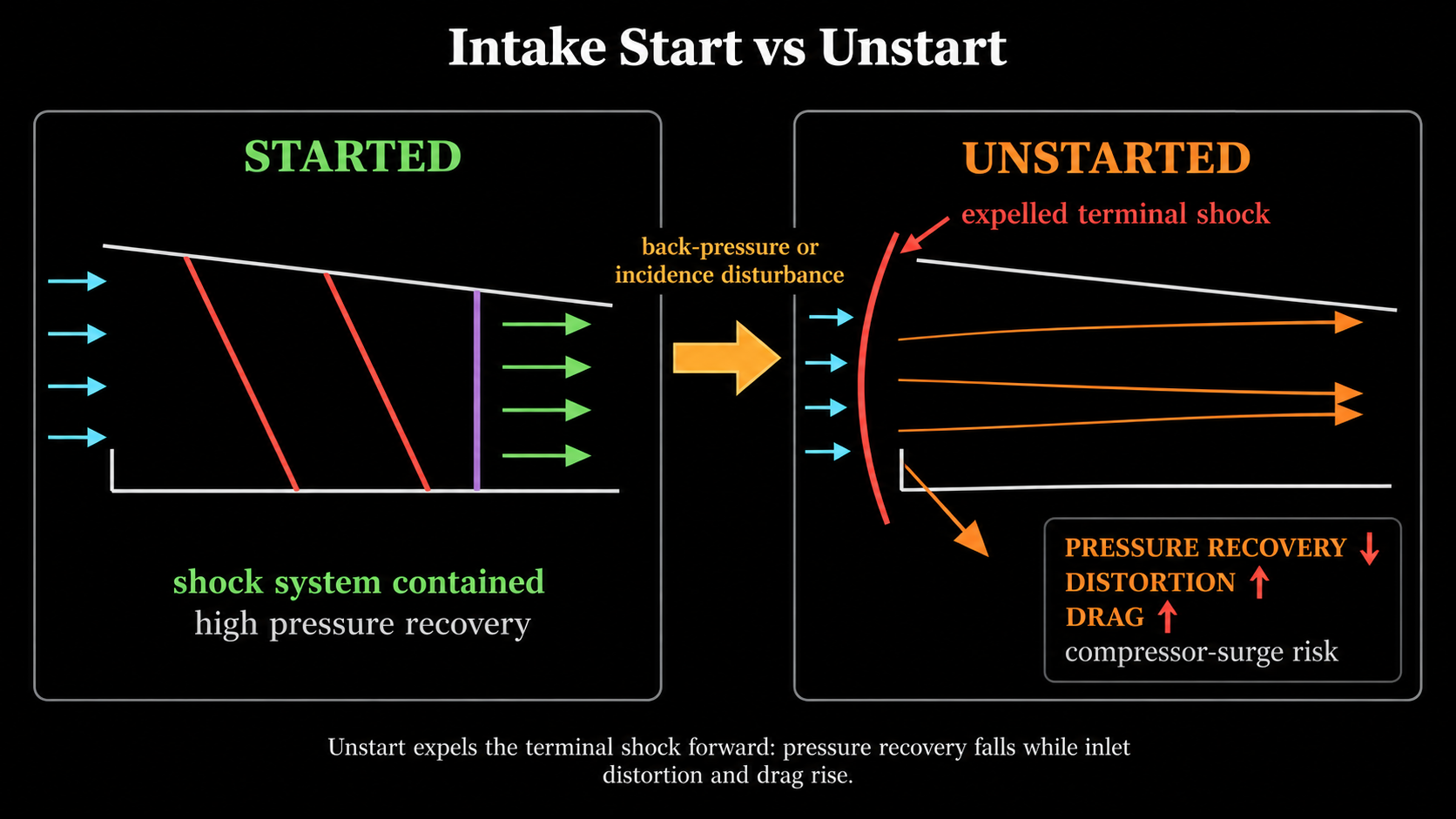
This is the phenomenon behind intake unstart. If the shock system moves to the wrong position, the intake can abruptly lose pressure recovery and deliver badly distorted flow to the engine. On a multi-engine aircraft, the sudden drag and thrust asymmetry can be severe. Keeping the shocks where the designers intended was therefore both an efficiency problem and a flight-safety problem. [8]
The four Rolls-Royce/SNECMA Olympus 593 engines were derived from the Olympus family used in the Avro Vulcan but extensively developed for Concorde. Each produced roughly 169 kN of thrust with reheat at take-off. Reheat — the British/Australian term for what American writing usually calls an afterburner — injected additional fuel downstream of the turbine to produce extra thrust at the cost of very high fuel consumption. [9]
Concorde used reheat for take-off and during transonic acceleration, but crucially not for sustained Mach 2 cruise. Once the aircraft had accelerated sufficiently, reheat was switched off and the integrated intake-engine-nozzle system carried the aircraft onwards in dry thrust. That distinction is one of the reasons Concorde was a practical transport rather than simply an enormous fighter.
The exhaust system completed the process. Variable secondary nozzles adapted the exhaust expansion across the flight envelope and also incorporated thrust-reverser functions. At Mach 2, a remarkable proportion of the propulsion system's useful effect came from the intake and nozzle rather than from thinking of the engine core alone. Supersonic propulsion is therefore best understood as an integrated flowpath extending from the first shock ahead of the intake to the final expansion of the exhaust. [8][9]
An Aircraft That Gets Hot — and Grows
At ordinary airline speeds, aerodynamic heating is present but rarely dominates the structural design. At Mach 2 it becomes impossible to ignore. [7]
The effect is sometimes described loosely as “air friction”, but the more useful picture is that high-speed airflow carries substantial kinetic energy. Where the flow is slowed and compressed around the aircraft, some of that energy appears as internal energy and therefore temperature. The nose and leading edges, where the flow is disturbed most strongly, become particularly hot.
MATHS INSET — The Kinetic Heating Problem
A useful upper-reference temperature is the stagnation temperature: the temperature reached if the flow is brought adiabatically to rest.
At roughly 18 km (about 60,000 ft) in the standard atmosphere, . Taking and ,
This is not a direct prediction of skin temperature. Real surface temperature depends on the local flow field, boundary-layer recovery, convection, radiation and conduction through the structure. Concorde's nose could reach operating temperatures of about , but that figure represents a different operating condition and should not be compared directly with this particular standard-atmosphere calculation.
What this tells us: the term makes heating grow rapidly with speed. Around Mach 2, temperature becomes a first-order aircraft-design constraint rather than a minor correction.
Concorde's structure was predominantly built from heat-resistant aluminium alloy rather than titanium. Aluminium was cheaper, familiar to manufacture and much easier to incorporate into a civil aircraft production system, but it placed a practical ceiling on sustained speed. The design therefore settled around Mach 2 rather than chasing the much higher Mach numbers imagined for some American SST concepts. [7]
The heating was not uniform. The nose could reach around 127 °C, while the tail remained cooler. White paint was not merely aesthetic: high reflectivity helped manage radiative heat absorption. Engine bays and other hotter regions used materials such as steels, nickel alloys and titanium where aluminium was unsuitable. [7]
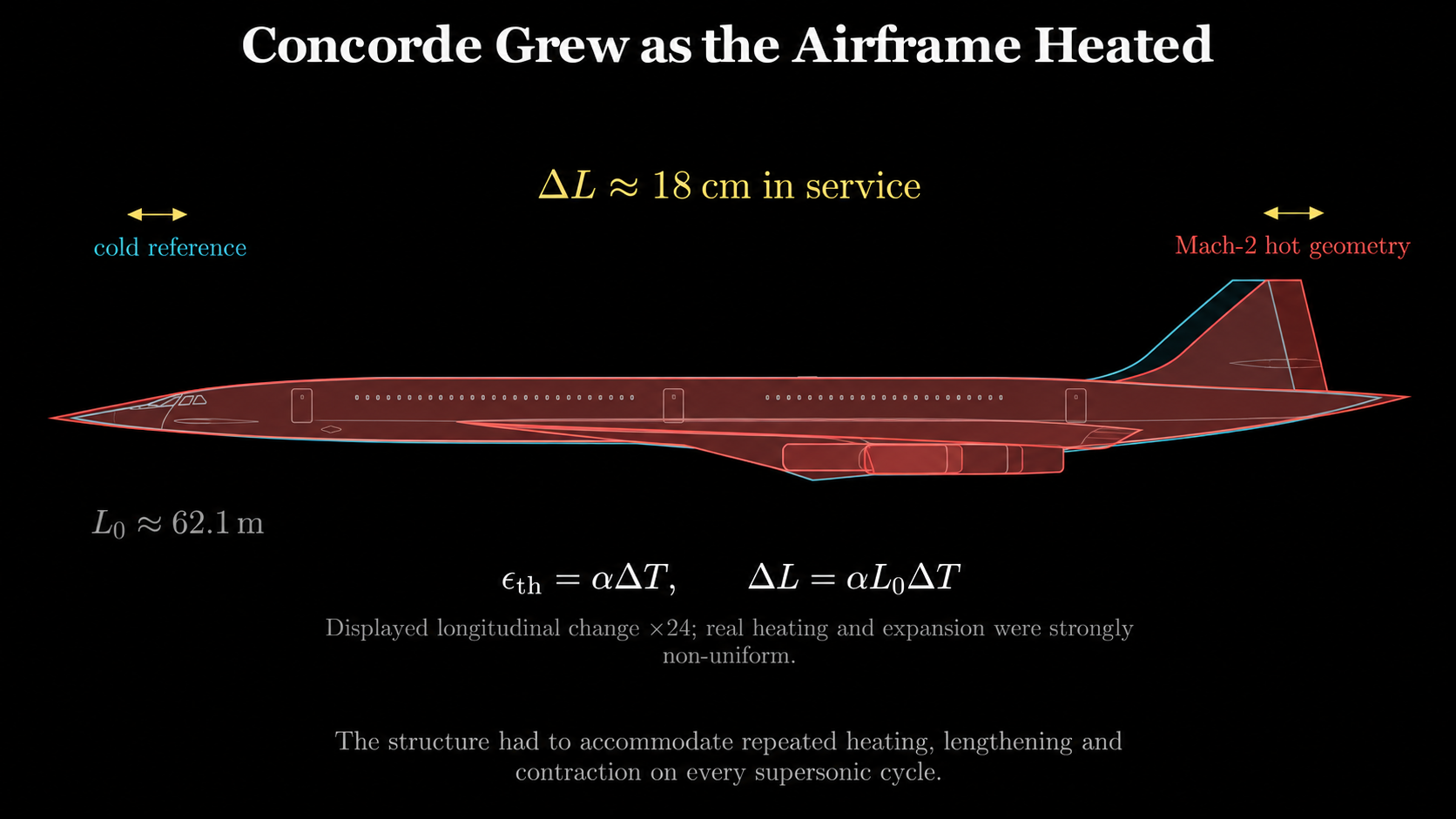
Heating a 62-metre aeroplane also changes its size. [7]
MATHS INSET — When a 62-Metre Aeroplane Gets Hot
For a material experiencing a temperature change , thermal strain is approximately
where is the coefficient of thermal expansion. Over an initial length ,
The strain is small, but Concorde was long enough for small strains to accumulate into a visible change in dimensions. The real calculation is more complicated because the temperature field was highly non-uniform.
In service, Concorde could lengthen by about 18 cm between its cold and fully heated states.
What this tells us: the structure did not merely have to survive heating. It had to tolerate changing dimensions every time the aircraft accelerated to cruise and then contract again after landing.
Expansion joints, seals, wiring, hydraulic lines and control linkages all had to accommodate that movement. Even mechanical control runs required provisions for length changes caused by thermal expansion. Fuel tanks changed volume, gaps opened and closed, and the entire aircraft repeatedly experienced a thermal cycle that a conventional subsonic airliner largely avoided.
The fuel helped solve the thermal problem as well. Rather than being only dead weight waiting to be burned, it served as a large heat sink for aircraft systems. Heat from the cabin, hydraulics and other equipment could be transferred into the fuel before the fuel was eventually consumed by the engines. [6][7]
Fuel as Part of the Flight-Control System
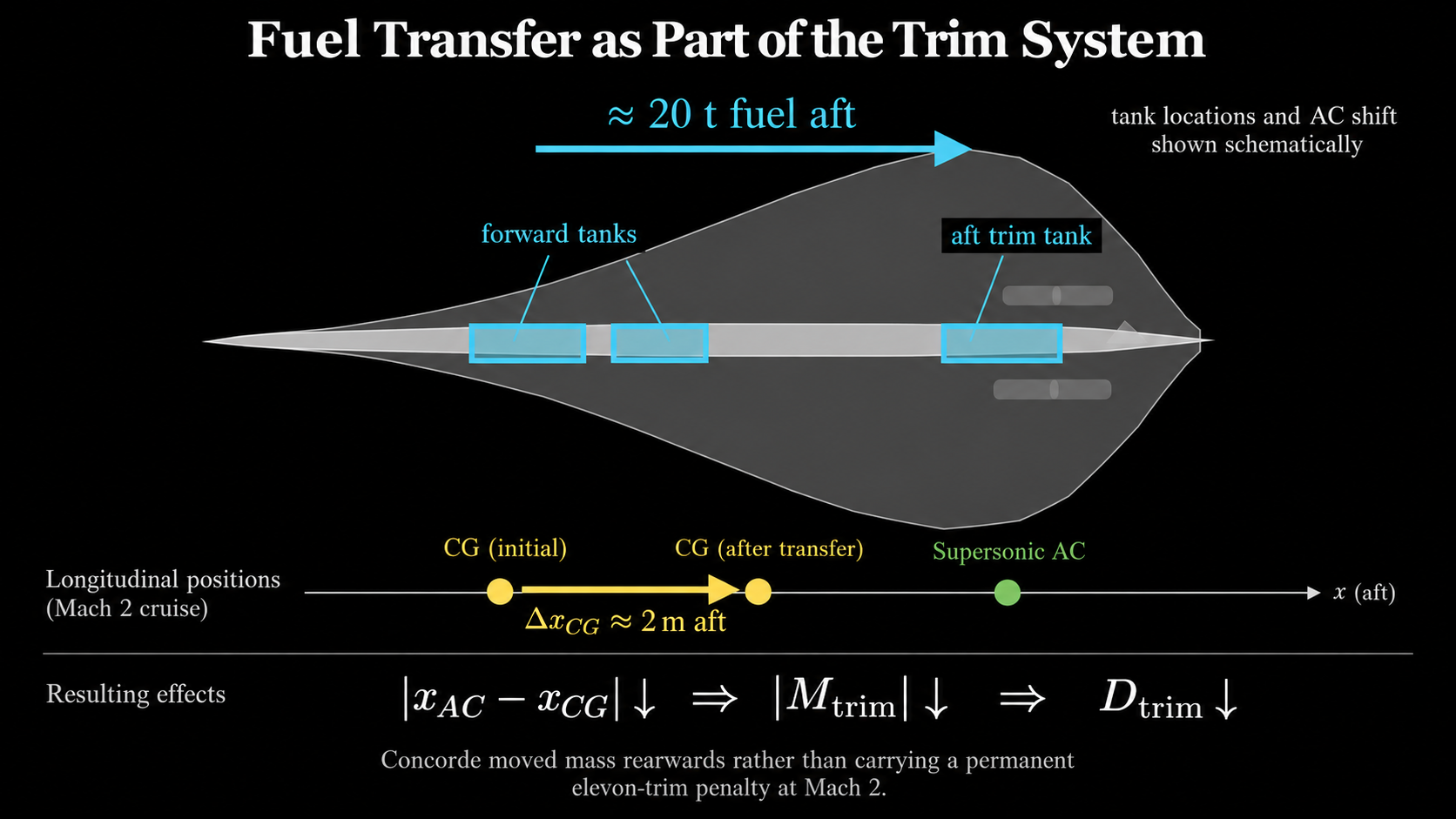
Concorde's fuel system is one of the clearest examples of how deeply coupled the aircraft's systems became. [6]
As an aeroplane accelerates from subsonic to supersonic flight, the pressure distribution over its wing changes. On Concorde, the effective centre of lift moved rearwards. If the centre of gravity remained where it had been at low speed, the growing separation between the two would create a pitching moment that had to be balanced continuously with elevon deflection. That would work, but it would create trim drag — exactly the kind of permanent efficiency penalty a fuel-hungry SST could not afford. [6][10]
Concorde instead moved the aircraft's mass.
Thirteen integral fuel tanks were distributed through the wings and fuselage. During acceleration, roughly 20 tonnes of fuel could be transferred rearwards, shifting the centre of gravity by about 2 metres. During deceleration the process was reversed. [6]
MATHS INSET — Moving Twenty Tonnes of Fuel to Trim an Aeroplane
A simplified pitching moment from lift can be written as
where represents the effective aerodynamic centre and the centre of gravity.
The centre of gravity is a mass-weighted average:
Moving a fuel mass from a forward tank to an aft tank changes that average and moves rearwards.
What this tells us: on Concorde, fuel was not merely energy for the engines. Tens of tonnes of it formed a movable mass that became part of the aircraft's aerodynamic control strategy.
Calling the fuel system a “third flight-control system” is not much of an exaggeration. The elevons controlled the aircraft dynamically, the autostabilisation system helped manage its response, and fuel transfer slowly moved the balance point to keep the airframe efficient as the aerodynamic regime changed. [6]
Making Mach 2 Feel Like an Airline Flight
At around 18 km altitude, the outside environment is extremely hostile to passengers. Atmospheric pressure is only a small fraction of sea-level pressure and temperatures are around before aerodynamic heating is considered. A rapid decompression at that altitude gives occupants very little useful consciousness time. [7]
Concorde's small windows were therefore more than a styling quirk. Smaller openings reduce the structural interruption in a pressurised fuselage and limit the area through which pressure can be lost if a window fails. The cabin and environmental-control systems had to preserve an ordinary human environment inside an aircraft operating at an extraordinary altitude. [7]
Cooling was just as important as heating. Engine bleed air could be extremely hot, the aircraft skin itself heated during cruise, electronics and hydraulics generated additional heat, and the cabin still had to remain comfortable. Fuel-air heat exchangers used the fuel as a thermal sink, coupling the environmental-control system to the same fuel network already responsible for range, balance and structural heat management. [6][7]
Noise was another compromise. The Olympus installation and high-speed airflow produced a cabin environment noticeably noisier than a modern wide-body, especially towards the rear. Yet the service had to be sold as premium travel rather than as an endurance test. Concorde's achievement was repeatedly turning these extreme external conditions into something passengers could largely ignore. [5][11]
The Sonic Boom — When the Engineering Problem Reaches the Ground
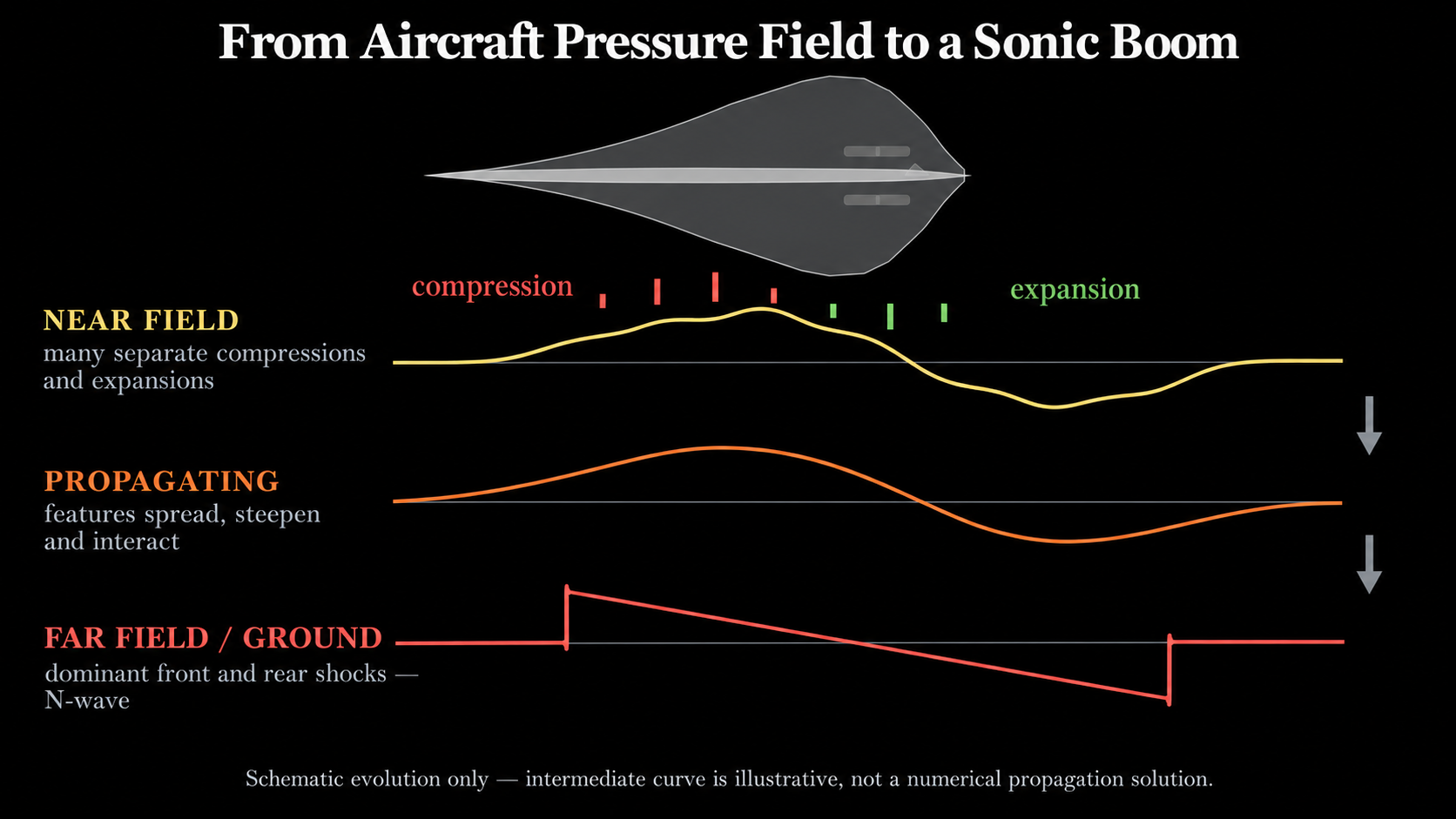
The shock waves around a supersonic aircraft do not stop existing once they have passed the wing. They propagate outwards through the atmosphere. [3][12]
Close to the aircraft, the pressure field is complicated. The nose, wing, intakes, nacelles and tail all generate separate compressions and expansions. As those disturbances travel away from the aircraft they interact, spread and tend to merge into a simpler far-field signature. By the time the disturbance reaches an observer on the ground, a conventional slender supersonic aircraft often produces the characteristic N-wave: a sudden positive pressure jump, a gradual decline through ambient pressure, and a final jump back towards normal conditions. [3][12]
The important point is that a sonic boom is not a one-off sound produced when the aircraft “breaks the sound barrier”. As long as the aeroplane remains supersonic, it continuously generates a moving pressure field. The Mach cone intersects the ground in a swath that travels with the aircraft. People beneath that boom carpet hear the disturbance as it passes them. [12]
For Concorde, typical overpressure beneath the flight path was enough to startle people, rattle windows and generate sustained political opposition. The problem was therefore fundamentally different from ordinary airport noise. Airport noise is concentrated around airports. A sonic boom can affect communities hundreds of kilometres away from either departure or destination. [11][12]
Australia provides a particularly intuitive way to think about the consequence. A supersonic Sydney–Perth service sounds enormously attractive on a map: roughly 3,300 km of domestic travel is exactly the sort of distance at which speed could matter. But it is also overwhelmingly an overland route. A conventional Concorde-like boom would follow the aircraft across a large part of the continent. Australia's geography therefore makes the overland-boom problem, rather than just raw aircraft performance, central to any future domestic SST proposition. [6][12]
Australian aviation regulation also treats supersonic aircraft as a special case. Operations require specific approval under aircraft-noise regulation, and Australian airspace planning has long recognised the practical constraint that supersonic flight producing booms is generally conducted over water. The regulatory details differ from the United States, but the underlying problem is the same: a commercially useful SST needs permission not merely to take off and land, but to use its speed where people live underneath it. [13]
That restriction was devastating to Concorde's economics. The aircraft could exploit Mach 2 over oceans, but many potentially attractive city pairs required long subsonic segments over land. A machine optimised around supersonic cruise is a very expensive way to fly subsonically. [5][12]
Why Didn't Concorde Take Over the World?
Concorde was a technical triumph. That did not automatically make it a scalable commercial transport.
Fuel and range were the first problem. Supersonic wave drag, high cruise thrust requirements and the small passenger cabin produced fuel consumption per passenger far above that of contemporary subsonic wide-bodies. Concorde's useful range was ideal for the North Atlantic but much less suited to very long routes without refuelling. For an Australian reader, this matters immediately: London–Sydney is not merely a slightly longer version of London–New York. Even an SST capable of crossing the Atlantic comfortably would need substantially more range, a stop, or a different operating concept to serve Australia efficiently. [5]
Airport noise was the second. Reheat, high exhaust velocities and the thrust required to move a heavily loaded delta-wing aircraft from a runway made take-off spectacular but loud. Noise-abatement procedures helped, but they also added operational constraints. [5][11]
Route restrictions were perhaps even more damaging. The sonic boom removed much of the advantage on overland sectors, which meant airlines could not simply deploy Concorde wherever wealthy passengers wanted to go. The aircraft needed routes with a large proportion over ocean, enough demand for premium fares, and airports capable of supporting its specialised operation. [5][12]
Capacity and utilisation mattered as well. A typical Concorde carried around 100 passengers. A Boeing 747 could carry several times that number. The 747 represented the other great vision of the jet age: not making a small number of passengers travel dramatically faster, but making long-distance flight cheaper and accessible to far more people. Economically, that was the future the market chose. [5]
The 1973 oil crisis arrived at almost the worst possible moment for the SST concept. Fuel prices and environmental concern rose just as airlines were being asked to commit to an aircraft whose business case already depended on expensive fuel and premium tickets. Most tentative orders disappeared. Only British Airways and Air France ultimately operated Concorde in scheduled service. [5]
It is also worth separating the programme economics from the later airline operation. Concorde's development costs were enormous and were borne heavily by the British and French governments. The small production run could never recover that investment in the way a successful mass-produced airliner programme might. Yet mature British Airways Concorde operations could still make money on selected premium routes once the aircraft had effectively been acquired on unusually favourable terms. “Concorde was uneconomic” is therefore true in one sense and misleading in another. [5]
The deeper problem was scalability. Concorde proved that an airline could operate a Mach 2 passenger service safely for decades. It did not prove that hundreds or thousands of SSTs could coexist with fuel prices, community noise expectations, environmental regulation and the route flexibility demanded by global airline networks. [5]
Can We Do It Better Now?
Half a century later, the engineering toolbox is substantially better. Modern computational fluid dynamics can explore shock interactions that once demanded enormous wind-tunnel programmes. Composite materials allow designers to trade stiffness, mass and temperature capability differently. Digital flight control and engine control are routine. Optimisation can shape an entire aircraft around its pressure signature rather than treating the sonic boom as an unavoidable by-product. [14]
The most important change is that modern low-boom research attacks the pressure field at its source. [14]
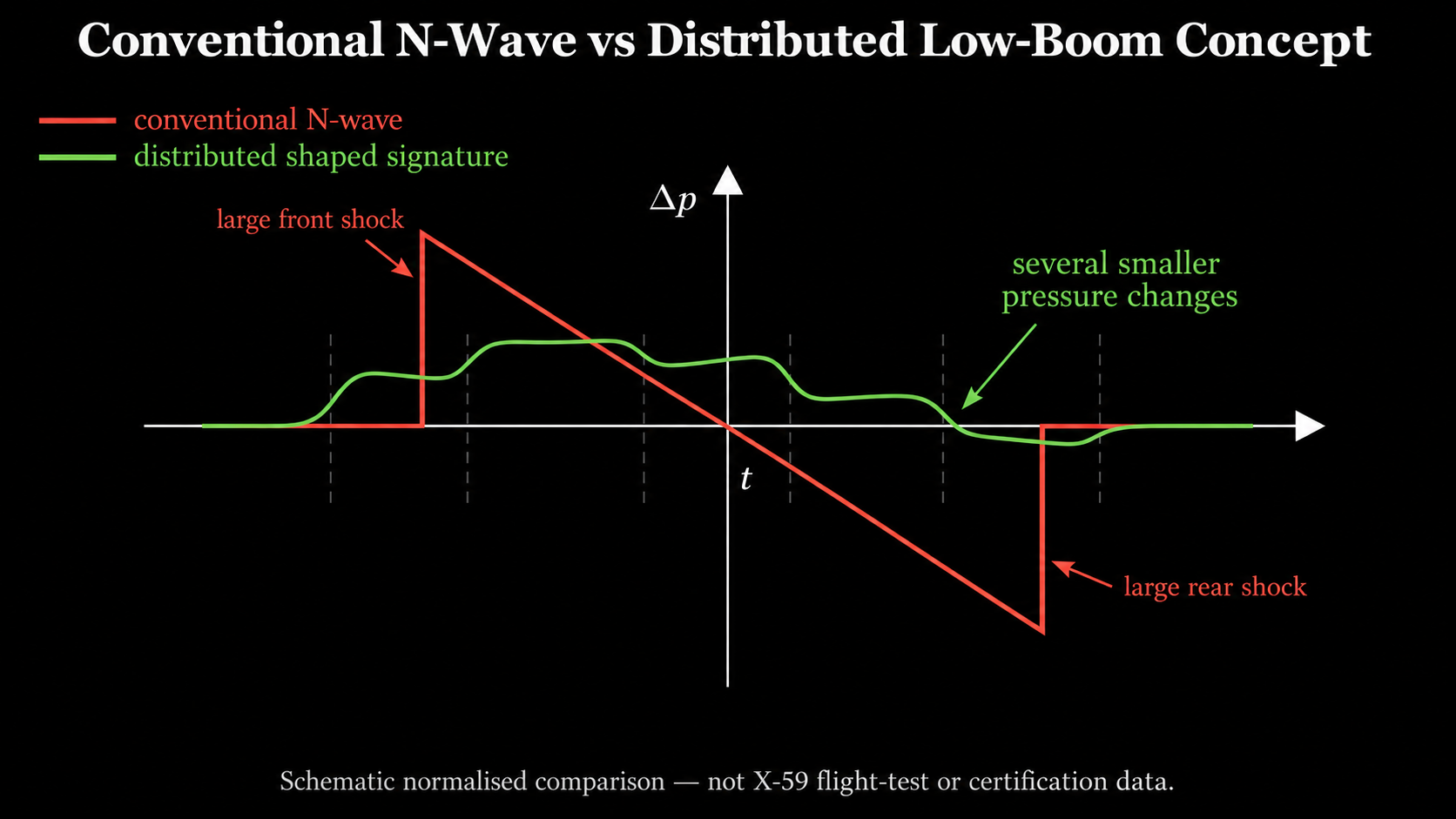
Instead of allowing the aircraft's many shocks to merge into two strong pressure jumps, a low-boom aircraft is shaped so that its compression and expansion features remain distributed as they propagate towards the ground. The objective is not to make the aircraft silent; it is to replace the sharp boom with a much softer pressure signature that communities may find acceptable. [14]
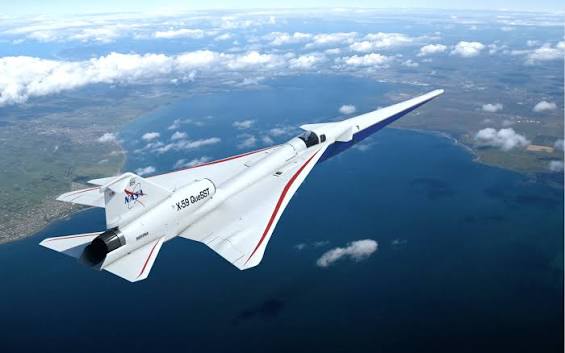
NASA's X-59 Quesst aircraft is the most visible demonstration of this approach. It completed its first supersonic flight on 5 June 2026, reaching about Mach 1.1. Only a week later, on 12 June, it reached its intended mission condition of Mach 1.4 at 55,000 ft. The next major phases are acoustic validation and, ultimately, community-response flights intended to provide regulators with real data on how people perceive a shaped sonic thump. [14]
The X-59 is not a passenger-aircraft prototype. Its job is more fundamental: to test whether the regulatory premise can change from “supersonic flight over land is prohibited” to “supersonic flight is permitted if its noise signature is acceptable.” If that shift occurs internationally, aircraft designers gain access to routes that Concorde could never use at full speed. [14]
Commercial projects are trying to solve the rest of the problem. Boom Supersonic's Overture concept targets a lower cruise Mach number than Concorde and combines modern aerodynamics, materials and propulsion development with a business model focused on premium long-distance travel. As with any aircraft still in development, company performance and schedule claims should be treated as targets rather than established capability. [15]
The regulatory picture is also still evolving. In the United States, the longstanding prohibition on routine civil supersonic flight over land remains in force while rulemaking is underway: in July 2026 the FAA proposed replacing the general Mach-number-based ban with a performance- and noise-based framework, including an interim supersonic noise-certification standard. Internationally, ICAO adopted new noise requirements in March 2026 under which new supersonic aircraft types will, from 2029, have to meet the airport-noise limits applicable to current subsonic aircraft, while work continues on a separate en-route sonic-boom certification scheme. In Australia, any future SST would also have to fit within local aircraft-noise approvals and airspace rules rather than simply inheriting an American or international regulatory outcome. [16, 17]
For Australia, a successful low-boom standard could be unusually significant. The country has very long domestic sectors, large distances between capital cities and an enormous surrounding ocean. Sydney–Perth, Brisbane–Perth and international routes into Asia or across the Pacific all make speed attractive — but only if the aircraft can use that speed without laying an unacceptable boom carpet over communities or spending much of the journey throttled back below Mach 1. [17, 13]
That is why the modern SST problem is not simply “build Concorde again with carbon fibre”. The next successful supersonic airliner has to improve the system: boom, fuel burn, airport noise, range, maintenance, emissions, certification and economics at the same time. [14][15][16][17]
Final Thoughts
Perhaps Concorde's greatest achievement was not speed itself, but the successful translation of a hostile aerodynamic regime into something that behaved, day after day, like an airliner. [5][8]
Passengers boarded, sat in ordinary-looking seats, ate meals, looked through surprisingly small windows and arrived across the Atlantic in roughly half the time of a conventional jet. Around them, however, the aircraft was doing things no ordinary airliner needed to do. Its intakes were continuously positioning shock waves. Its structure was heating and lengthening. Tens of tonnes of fuel were being moved to alter its balance. Its wing was using entirely different aerodynamic mechanisms at cruise and on approach. Its environmental systems were using that same fuel as a heat sink while four Olympus engines operated inside an integrated propulsion system stretching from the intake shocks to the exhaust nozzles. [5]
That is what makes Concorde more interesting than simply quoting Mach 2.02. It was a machine in which aerodynamics, thermodynamics, structures, propulsion, controls and operations became inseparable. [5][6][7][8]
It also explains why the answer to “why haven't we done it again?” is not that the technology was forgotten. We know how to make an aircraft fly supersonically. We know how to make one fly at Mach 2. The difficult question is whether we can make the resulting aircraft quiet enough, efficient enough, flexible enough and cheap enough to deserve a place in modern civil aviation. [5][14]
The X-59 is testing one part of that question. New commercial programmes are testing others. Regulators are being asked to reconsider rules written in response to an earlier generation of aircraft. None of that guarantees a second supersonic age, but it does mean the problem is alive again. [14][15][16][17]
For a few decades, humanity sold tickets on an aircraft that could outrun the sound of its own engines.
The remarkable part is not that it was fast.
The remarkable part is everything engineers had to make work so that, to the people sitting inside it, Mach 2 could feel almost ordinary.
References
- National Museums Scotland. Concorde: The story of supersonic passenger flight. Historical chronology, first transatlantic crossing and early commercial service.
National Museums Scotland — Concorde: The story of supersonic passenger flight
- NASA. First Generation X-1. Historical account of the Bell X-1 programme and Yeager's first supersonic flight.
- NACA. NACA Report 1135: Equations, Tables, and Charts for Compressible Flow. 1953. Compressible-flow, normal-shock, oblique-shock and Prandtl–Meyer relations.
- NASA Glenn Research Center. Oblique Shock Wave Equations. Compressible-flow and oblique-shock fundamentals.
NASA Glenn — Oblique Shock Wave Equations
- Smithsonian National Air and Space Museum. The Evolution of the Commercial Airliner. Concorde, Tu-144 and Boeing 2707 history and commercial context.
Smithsonian — The Evolution of the Commercial Airliner
- Heritage Concorde. Concorde Fuel Transfer and Concorde Fuel System – General Description. Fuel transfer, centre-of-gravity management and thermal-system integration.
Heritage Concorde — Fuel Transfer
Heritage Concorde — Fuel System General Description
- Heritage Concorde. Concorde Airframe Materials and Concorde Airframe Performance. Airframe materials, temperatures, thermal expansion and operating environment.
Heritage Concorde — Airframe Materials
Heritage Concorde — Airframe Performance
- Heritage Concorde. Concorde Air Intakes and Concorde Engineers Panel – Air Intake Control. Variable-geometry intake operation, shock control and digital intake control.
Heritage Concorde — Air Intake System
Heritage Concorde — Engineers Panel: Air Intake Control
- Heritage Concorde. Concorde Olympus 593 Mk610 Engines. Olympus 593 propulsion and high-temperature engine operation.
Heritage Concorde — Olympus 593 Mk610 Engines
- Smithsonian Air & Space Magazine. Mach 2 on the Concorde. Operational account of fuel transfer during acceleration and Concorde cruise.
Smithsonian Air & Space Magazine — Mach 2 on the Concorde
- U.S. Environmental Protection Agency. Noise Measurement of Concorde 02 Approach and Takeoff at Dallas-Ft. Worth and Dulles International Airports. 1973 Concorde noise measurements and sonic-boom context.
EPA — Concorde Noise Measurement Report
- ICAO. Supersonic Aircraft Noise Standards Development. Current work on en-route sonic-boom measurement and certification procedures.
ICAO — Supersonic Aircraft Noise Standards Development
- TAA Museum. TAA Tales — June 1972 Concorde visit to Australia and Australian noise/sonic-boom evaluation context.
TAA Museum — TAA Tales: Concorde in Australia
- NASA Quesst. X-59 Aircraft Flies Supersonic for First Time and X-59 Reaches Speed, Altitude for Future Quiet Supersonic Flights. June 2026 flight-test milestones and low-boom research programme.
NASA — X-59 Aircraft Flies Supersonic for First Time
NASA — X-59 Reaches Speed and Altitude for Future Quiet Supersonic Flights
- Boom Supersonic. Overture — current manufacturer targets and programme claims. These figures are manufacturer claims, not demonstrated production-aircraft performance.
- U.S. Department of Transportation / FAA. Enabling Supersonic Overland Flight, Federal Register, 2026-13440. July 2026 proposed rulemaking.
U.S. Department of Transportation — Enabling Supersonic Overland Flight
- ICAO. New aircraft will face stricter environmental standards. 27 March 2026. New noise standards and their application to future supersonic aircraft from 2029.
ICAO — New aircraft will face stricter environmental standards