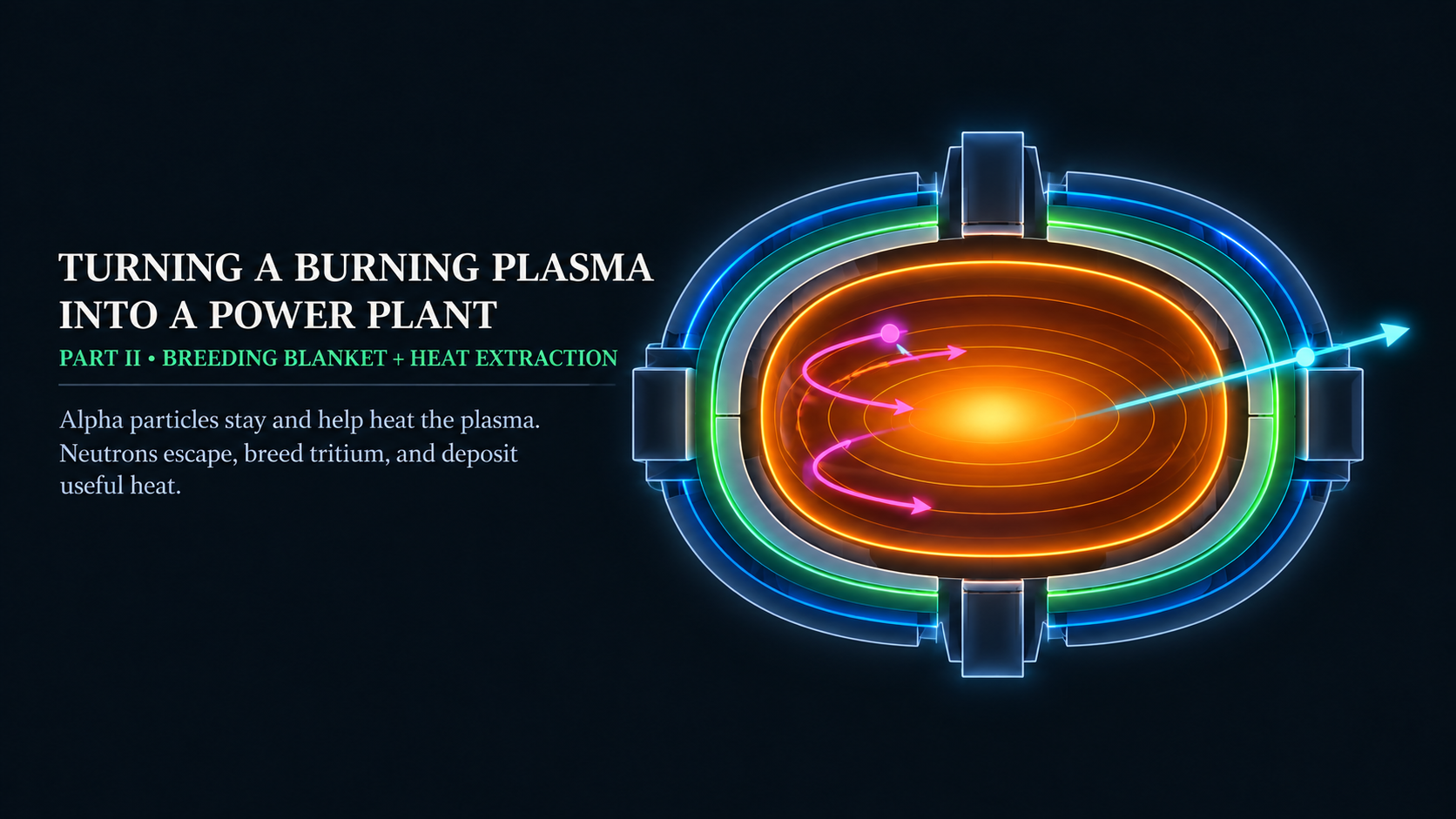
Turning a Burning Plasma into a Power Plant
Reaching fusion conditions is only the beginning. This article examines how a burning tokamak couples alpha self-heating, neutron transport, tritium breeding, superconducting magnets, plasma exhaust, state estimation, and multirate feedback control into a complete fusion power system.
35
minutes
7,028
words approx.
5
indexed topics
23 AUG
2026
The Tokamak — Part II: Turning a Burning Plasma into a Power Plant
Part I developed the tokamak from a single physical contradiction.
Useful deuterium-tritium fusion requires a plasma at temperatures on the order of one hundred million kelvin, yet no conventional material can directly contain such a fuel. Magnetic fields therefore replace the function of a material wall. A toroidal geometry closes the ends of the magnetic bottle, a poloidal field twists the magnetic field into helices, and the plasma current becomes part of the confinement system itself. [21][1]
That solution is already considerably more complicated than simply "holding plasma with magnets".
The helical field introduces a safety-factor profile. The safety-factor profile influences MHD stability. The current required to generate the poloidal field depends upon plasma conductivity. Conductivity changes with temperature. Heating and turbulence therefore influence the magnetic equilibrium, while the magnetic equilibrium determines whether the plasma remains stable enough for heating to be useful.
At the end of Part I, this coupled system reached a critical transition.
Fusion-produced alpha particles became energetic enough and numerous enough to contribute meaningful heating to the fuel.
The energy balance changed from [21][3]
to
At first glance, this is only one additional term.
Yet this seemingly modest change transforms the reactor entirely.
Before significant alpha heating, the plasma is primarily a difficult electromagnetic and thermal load. External systems deposit energy, magnetic fields establish the equilibrium, and transport removes some fraction of the stored energy.
Once alpha heating becomes significant, the plasma begins contributing to its own thermal input.
Temperature influences fusion reactivity.
Fusion reactivity determines alpha production.
Alpha particles deposit heat.
That heat modifies temperature.
The plasma has acquired an internal positive-feedback mechanism.
At the same time, every fusion reaction produces a 14.1 MeV neutron that ignores the magnetic field, leaves the plasma, and deposits its energy into the surrounding machine. Those neutrons must become useful heat, breed replacement tritium, and avoid destroying the magnets and structural materials required to keep the reactor operating.
The engineering problem therefore changes again.
The tokamak is no longer only a machine designed to maintain plasma conditions.
It must become a complete nuclear power system in which plasma dynamics, neutron transport, superconducting magnets, fuel breeding, material limits and real-time control all remain compatible.
This article develops that second half of the machine: how a burning plasma sustains itself, how neutron energy becomes electricity and future fuel, why the surrounding hardware experiences some of the most extreme conditions in engineering, and why a reactor-scale tokamak must ultimately be treated as a nonlinear feedback-controlled system.
When the Plasma Starts Heating Itself
The deuterium-tritium reaction is
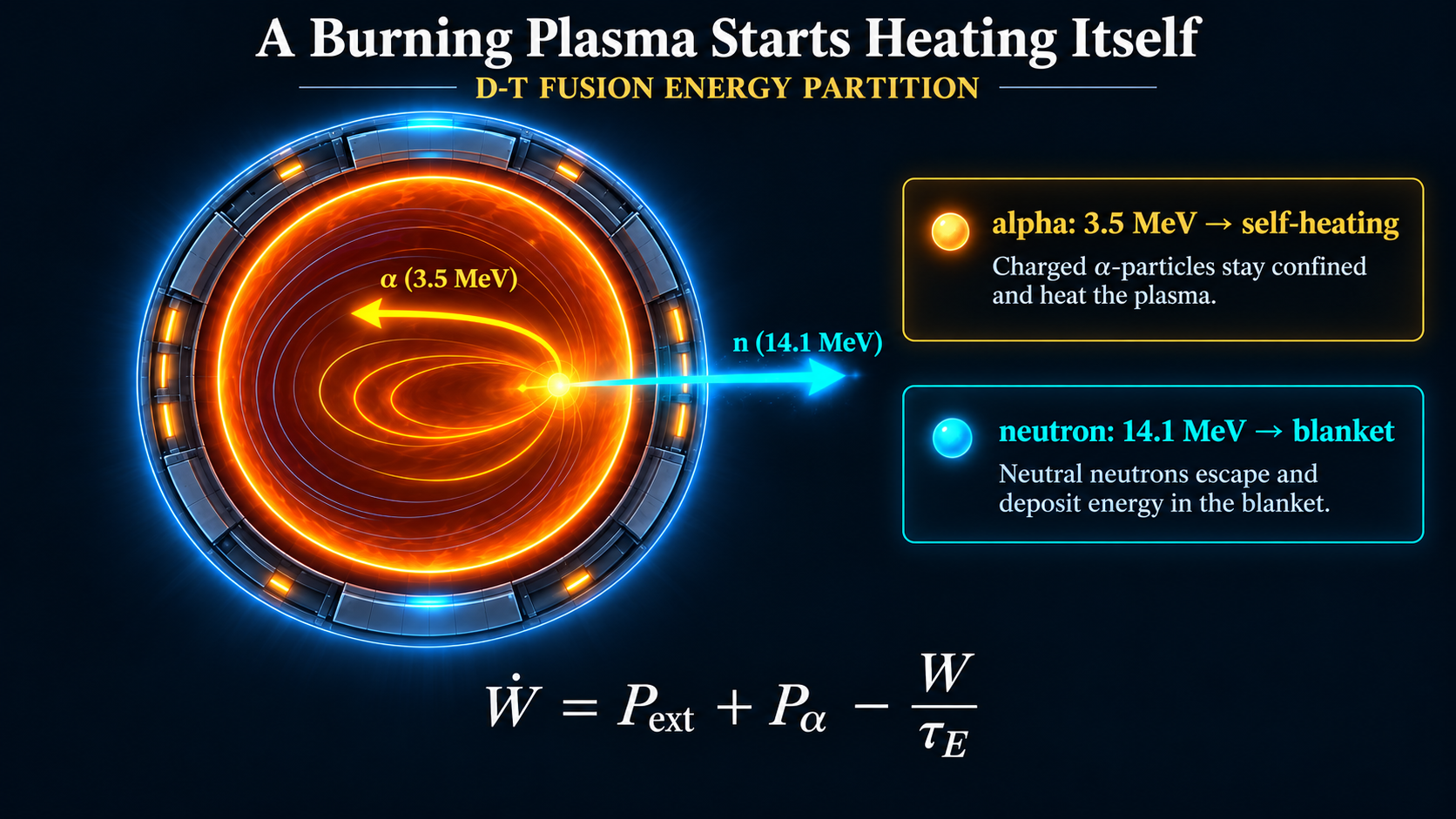
The reaction energy is divided primarily between the charged alpha particle and the neutron,
The alpha particle therefore carries roughly [21]
of the fusion energy.
The remaining eighty percent leaves with the neutron.
This division creates two completely different engineering pathways.
The alpha particle has charge
It remains tied to the magnetic field and slows through collisions with the surrounding plasma. Its kinetic energy is therefore redeposited into the fuel.
The neutron has
The Lorentz force does essentially nothing to it, so it leaves the plasma and enters the surrounding blanket.
The alpha particle is therefore responsible for plasma self-heating.
The neutron is responsible for most of the reactor's extractable thermal power.
The alpha-heating term can be written approximately as [21]
where is the total fusion power.
The plasma-energy balance becomes
Using the energy-confinement time,
this becomes
At steady state,
so
This is the thermal operating point of the burning plasma.
The external heating systems developed in Part I are still important, but they no longer provide the entire thermal input. As the burn becomes stronger, the plasma increasingly sustains itself.
This is the fusion equivalent of moving from an externally excited system toward an internally powered one.
The important question is no longer simply whether the plasma can be heated to fusion temperature.
It is whether the internally heated equilibrium can be maintained without violating the many limits surrounding it.
Fusion Power Creates a Nonlinear Feedback Loop
The volumetric reaction rate for deuterium-tritium fusion is [21][1]
The fusion power density is therefore
The term
is strongly temperature dependent.
Consequently, increasing plasma temperature tends to increase fusion power.
That produces the sequence
This is a positive thermal-feedback path.
However, the plasma does not simply run away.
Transport removes energy.
Fuel is consumed.
Helium ash accumulates.
Radiation losses change with density and impurity concentration.
Pressure changes the MHD equilibrium.
Turbulence changes the confinement time.
The final burn state is therefore determined by several competing nonlinear feedback loops.
A useful reactor must operate at a point where
is sufficiently large to reduce the external heating requirement without pushing the plasma beyond thermal, magnetic or material constraints.
This is why simply achieving a large instantaneous fusion rate is not equivalent to producing a practical reactor.
The reaction has to be embedded inside a stable system-level operating point.
The Lawson Criterion as a Systems Requirement
The difficulty of magnetic-confinement fusion is often summarised through the Lawson criterion. [21][1]
A useful plasma requires adequate density,
temperature,
and energy-confinement time,
The resulting triple product is
The importance of this quantity becomes clearer when viewed through the reactor energy balance.
Higher density increases the number of potential reacting pairs.
Higher temperature increases the average reactivity,
Longer confinement time reduces the rate at which thermal energy escapes.
A deficit in one quantity cannot be compensated indefinitely by increasing another.
Density encounters operational limits.
Temperature changes stability, radiation and heating requirements.
Confinement is limited by turbulence and edge physics.
The Lawson criterion therefore represents more than a nuclear-physics threshold.
It is a compact statement that the fuel conditions and the quality of the magnetic bottle must become sufficient simultaneously.
This is also why advances in apparently unrelated tokamak subsystems can change reactor viability.
A stronger magnetic field may permit higher pressure.
Improved turbulence suppression may increase .
Better profile control may allow operation closer to stability boundaries.
No single improvement "solves fusion".
The practical burn state emerges from their interaction.
The Neutron Escapes the Magnetic Bottle
The alpha particle remains inside the plasma because it is charged.
The neutron does not.
For a charged particle,
For the neutron,
so
A 14.1 MeV neutron therefore passes through the confining magnetic field almost unaffected. [21]
At first glance, this appears to be a serious disadvantage.
Approximately eighty percent of the fusion energy immediately leaves the plasma.
In a power reactor, however, this is exactly how the majority of useful energy is extracted.
The neutron transfers its kinetic energy to the surrounding blanket.
The blanket then turns nuclear particle energy into ordinary thermal energy.
This is the point where the exotic plasma machine begins to reconnect with conventional power engineering.
But the blanket has another job that is at least as important.
It must manufacture the reactor's future fuel.
Tritium Changes the Fuel-Cycle Problem
Deuterium is naturally abundant.
Tritium is not.
Tritium is radioactive, with a half-life of roughly twelve years, and there is no large naturally occurring reserve from which a global fusion industry could draw indefinitely. [7][21]
A D-T reactor must therefore breed the tritium it consumes.
Lithium provides the primary mechanism. [7]
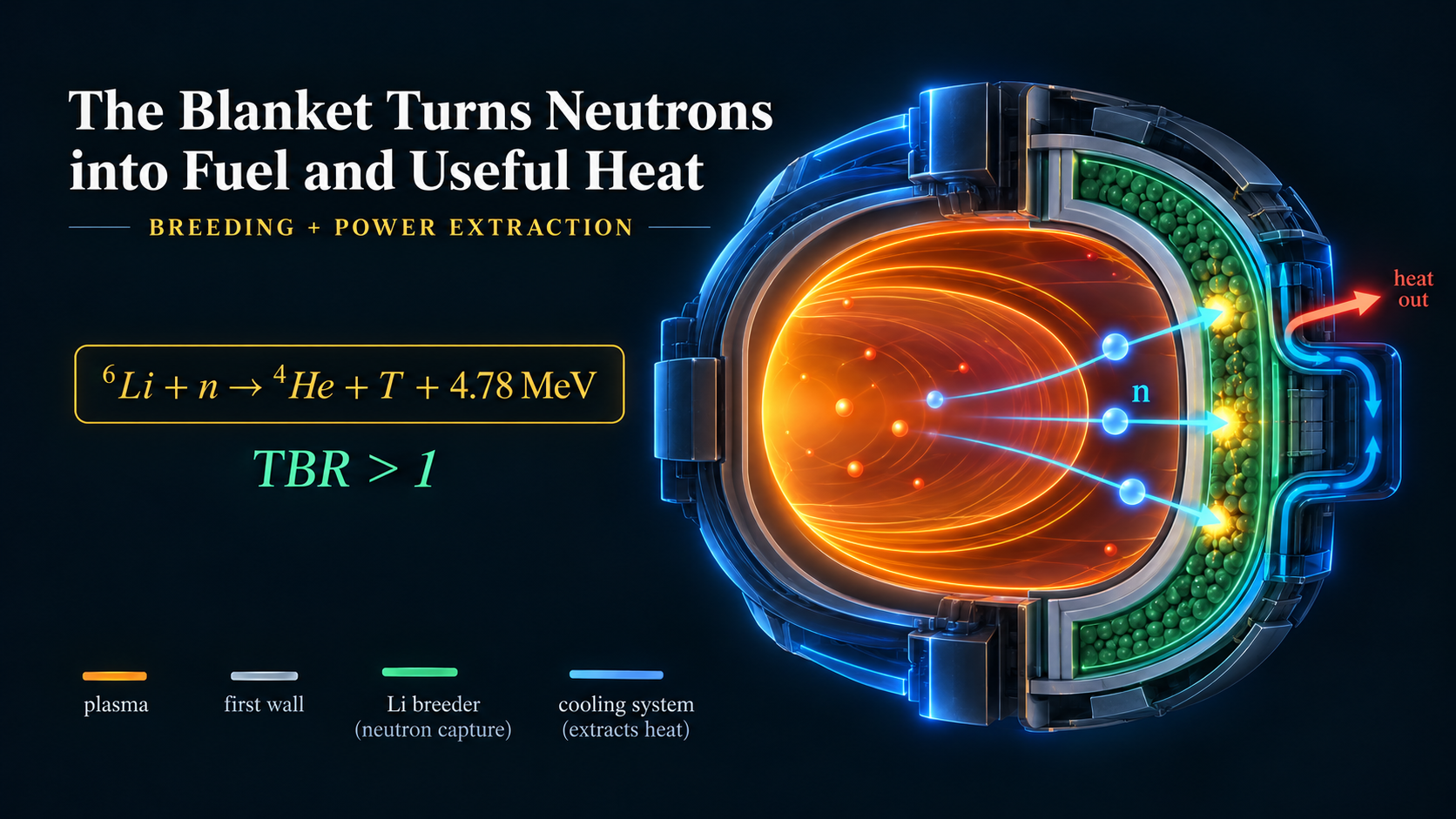
One important breeding reaction is
A neutron produced by one fusion reaction is therefore used to create a tritium nucleus capable of participating in a later reaction.
The reactor is not merely consuming fuel.
It is using its own neutron output to manufacture part of the next fuel cycle.
A useful metric is the tritium breeding ratio,
Self-sufficient operation requires
In practice, the required breeding ratio must exceed unity by a useful margin. Tritium is lost through processing, retained in materials, stored within plant inventories and lost through radioactive decay. [7]
This makes blanket geometry a constrained optimisation problem.
Material used for structural reinforcement does not breed tritium.
Coolant channels displace breeding material.
Diagnostic penetrations reduce neutron coverage.
Shielding intended to protect the superconducting magnets can absorb neutrons before they reach lithium.
The blanket therefore has to balance
- tritium production,
- neutron multiplication,
- structural strength,
- heat removal,
- radiation shielding,
- maintenance access.
The component surrounding the plasma becomes simultaneously a fuel factory, heat exchanger, neutron shield and load-bearing structure.
Turning Neutron Energy into Electricity
As energetic neutrons move through blanket material, they undergo nuclear collisions. [6][8]
Their kinetic energy is transferred into recoil nuclei, secondary particles and radiation.
Eventually, the energy becomes ordinary thermal motion.
The blanket heats.
Coolant removes this heat and transports it to a power-conversion system.
The complete energy pathway can therefore be represented as
After the enormous complexity required to create and maintain the plasma, the final energy-conversion stage becomes surprisingly conventional.
A fusion plant is still fundamentally a thermal power station.
The extraordinary engineering lies in the heat source and everything required to keep that heat source operating.
The Same Neutrons That Produce Power Also Damage the Reactor
Fast-neutron transport is useful because it carries energy from the plasma into the blanket. [8][6]
The same property makes the environment extremely difficult for materials.
A sufficiently energetic neutron collision can displace an atom from its lattice site.
This creates vacancies and interstitial defects.
Repeated bombardment produces cumulative radiation damage often characterised using displacements per atom, or DPA.
Over a reactor lifetime, this can contribute to
- embrittlement,
- swelling,
- creep,
- reduced thermal conductivity,
- changes in yield strength,
- dimensional instability.
Neutron reactions also transmute the material itself.
New isotopes are produced.
Some are radioactive.
Some reactions generate helium or hydrogen within structural materials, altering their microstructure and mechanical behaviour.
This means the first wall and blanket cannot be designed using ordinary high-temperature structural analysis alone.
The material properties evolve with neutron exposure.
The structure supporting the plasma is slowly modified by the reactor it supports.
This becomes one of the defining differences between a plasma experiment and a power reactor.
An experimental tokamak may demonstrate excellent confinement for a finite campaign.
A commercial reactor has to preserve acceptable structural, thermal and nuclear behaviour over an operating life measured in years.
The Divertor: Designing a Controlled Leak
Even a well-confined plasma cannot retain every particle indefinitely.
Fusion-produced alpha particles eventually slow down and become thermal helium.
At that point they are no longer contributing useful self-heating.
They become helium ash.
A simplified inventory equation is
If helium accumulates, it dilutes the deuterium-tritium fuel.
Impurities entering from material surfaces can also increase radiative losses and degrade the burn state.
The reactor therefore requires an exhaust pathway.
Tokamaks create this through the divertor. [5]
Near the plasma edge, external coils shape the magnetic field to form an X-point and separatrix.
Inside the separatrix, the magnetic surfaces remain closed.
Outside it, field lines intersect specially designed material surfaces.
Particles and heat leaving the confined plasma are guided toward these divertor targets rather than being distributed uniformly across the vacuum vessel.
The divertor therefore performs an unusual role. [5]
The reactor requires excellent confinement throughout the core while deliberately engineering a controlled region of poor confinement at the boundary.
This exhaust region must remove
- helium ash,
- plasma particles,
- impurities,
- thermal power.
At the same time, material eroded from the divertor must not contaminate the core.
The highest-performance magnetic bottle must therefore contain a carefully designed leak.
The Magnet System Lives in an Equally Extreme Environment
The plasma and blanket are surrounded by the magnetic system that makes the entire reactor possible.
For a magnetic field of magnitude , the characteristic magnetic pressure is [9][1]
This scales as
Increasing magnetic field strength can improve confinement and enable more compact reactor geometries, but the structural loading increases rapidly. [9]
The electromagnetic force density is
Toroidal-field coils therefore experience enormous forces produced by the fields they themselves generate.
This is one of the central engineering constraints on high-field tokamaks.
The magnets are not simply electrical components.
They are heavily loaded structural components whose electromagnetic, mechanical and thermal behaviour must remain compatible.
Why the Magnets Must Be Superconducting
A conventional conductor carrying current dissipates [9]
At reactor-scale magnet currents, even small resistance would produce unacceptable continuous power loss and heat generation.
Superconductors largely remove the resistive loss, but only while operating within a restricted region of current density, field and temperature.
A simplified operating condition is
The critical current density falls as magnetic field and temperature increase.
This creates one of the most striking thermal contrasts in engineering.
The plasma may have a characteristic temperature above
while the superconducting magnet system operates only a few kelvin above absolute zero.
Between them sits the vacuum vessel, first wall, blanket, neutron shield and cryostat.
The reactor therefore maintains some of the hottest matter deliberately created by humans within metres of one of the coldest large engineering systems.
This thermal separation is only possible because the plasma is magnetically isolated and the blanket intercepts the majority of neutron power.
Quench: When Superconductivity Is Lost
Superconductivity is not a permanent material property under all conditions. [10][9]
If a region of conductor becomes too warm, carries too much current, or experiences too strong a magnetic field, it can leave the superconducting state.
The local resistance becomes non-zero,
The existing current now produces Joule heating,
That heating raises the local temperature.
Neighbouring conductor may then also become resistive.
A normal zone begins to propagate.
This is a quench.
Large superconducting magnets can store enormous electromagnetic energy,
If too much of that energy is deposited into a small region, the conductor can be damaged. [10]
Quench-protection systems therefore monitor the magnet continuously for the appearance of resistive voltage.
Once a quench is detected, the objective changes rapidly from maintaining superconductivity to managing the stored energy safely.
The system may extract energy into external resistors, redistribute it through the winding, or deliberately spread the normal region.
This reflects a wider principle visible throughout tokamak engineering.
Protection does not always mean preventing a fault from beginning.
Sometimes the correct engineering response is to detect an unavoidable fault early and control how it develops.
A Burning Tokamak Has a Moving Operating Point
At this stage, the number of coupled physical domains has become substantial.
Consider a single change in auxiliary heating.
Increasing
raises plasma temperature.
Higher electron temperature reduces Spitzer resistivity,
The current distribution therefore evolves.
That modifies the safety-factor profile,
Magnetic shear changes.
MHD stability margins move.
Turbulent transport changes.
The confinement time,
may change.
Fusion reactivity changes.
Fusion power changes.
Alpha heating changes.
Pressure changes.
Neutron power changes.
Blanket heat load changes.
Tritium consumption changes.
The effect of a single actuator has propagated through electrical, magnetic, thermal, transport and nuclear domains.
This is the central systems-engineering difficulty of a burning tokamak.
The machine does not operate around a collection of independent steady-state subsystems.
It operates around a coupled and continuously evolving plasma state.
The Reactor Cannot Be Operated Open-Loop
A practical tokamak therefore cannot be controlled by choosing coil currents, heating powers and fuelling rates before a pulse and allowing the plasma to evolve without correction.
The plasma state must be observed and controlled continuously. [11][12]
A simplified state vector might be written
Representative actuator inputs might be
The nonlinear plant can therefore be expressed conceptually as
where represents disturbances such as transport fluctuations, impurities, wall interactions and MHD activity.
Diagnostics provide measurements,
In form, this resembles a conventional nonlinear control problem.
The important difficulty is that many of the states of interest cannot be measured directly.
There is no sensor that can simply be inserted into the core and continuously report
The reactor must infer them.
Reconstructing a Plasma That Cannot Be Touched
Tokamaks therefore use many complementary diagnostics. [11][12]
Magnetic probes and flux loops measure quantities related to the external magnetic field and plasma current.
Interferometry provides line-integrated density information.
Thomson scattering can infer electron density and temperature.
Spectroscopy provides information about composition and plasma conditions.
Electron-cyclotron emission reveals electron-temperature behaviour.
Neutron diagnostics provide information related to fusion activity.
Bolometry estimates radiated power.
Each diagnostic provides only part of the state.
These measurements must be combined with physical models to reconstruct the quantities required by the controller.
For magnetic equilibrium, real-time reconstruction solves an inverse problem related to the Grad-Shafranov equation developed in Part I.
The estimated state may include
- plasma boundary,
- magnetic axis,
- X-point location,
- flux surfaces,
- current distribution,
- safety-factor profile.
The controller therefore operates on
rather than the inaccessible true state,
The control problem is consequently inseparable from the estimation problem.
The machine has to reconstruct the plasma quickly enough to control the plasma it is reconstructing.
Vertical Stability: The Fastest Major Loop
Elongated plasmas can be unstable in the vertical direction. [13][11]
A small vertical displacement may grow approximately as
If
the displacement grows exponentially.
The equilibrium is therefore not passively stable.
Active feedback is required.
A reduced linear model around an operating point might be written
Using the estimated state, a feedback law such as
can command control coils to oppose the growing displacement.
The detailed plant includes conducting structures, coil dynamics, delays and actuator limitations, but the control philosophy remains familiar.
Measure or estimate the unstable state.
Apply a correcting input before the instability grows beyond the controllable region.
The plasma is therefore not merely shaped by the coils.
Its position is actively stabilised by them.
Shape Control Is a Multivariable Problem
The external poloidal-field coils also control the broader plasma geometry. [11]
Relevant variables include
- radial position,
- vertical position,
- elongation,
- triangularity,
- X-point location,
- divertor strike-point positions.
These variables are coupled.
Changing one coil affects several aspects of the plasma shape.
Changing one shape variable generally requires coordinated action from multiple coils.
Around a nominal operating point, the system can be linearised as
This is naturally a multiple-input multiple-output control problem.
The same mathematical structures encountered in aerospace and robotics—state estimation, multivariable feedback, constrained optimisation and predictive control—therefore appear in plasma control.
The physical plant is unusual.
The control problem is recognisably modern.
Current-Profile Control
The total plasma current,
is only part of the magnetic state.
The radial current-density distribution,
determines the poloidal magnetic field and therefore the safety-factor profile,
Since MHD stability depends strongly upon this profile, the controller must influence not merely how much current flows through the plasma, but where that current flows. [11]
Several actuators contribute.
Inductive drive generates bulk plasma current.
Neutral beams can drive current while heating the plasma.
Electron Cyclotron Current Drive can deposit current locally.
Bootstrap current emerges naturally from pressure gradients in a toroidal plasma.
The current profile evolves relatively slowly because magnetic flux diffuses through the plasma resistively.
A command applied now may therefore alter the magnetic state over a timescale far longer than the vertical-instability loop.
The same reactor contains processes requiring control responses from milliseconds to seconds and beyond.
This difference in timescale becomes one of the central architectural features of the control system.
Heating Systems Become Stability Actuators
The auxiliary heating systems introduced in Part I are not restricted to thermal control. [3][11]
Electron Cyclotron Current Drive can modify the current near a selected rational surface.
This allows localised suppression of magnetic islands and certain tearing modes.
Neutral beams influence
- heating,
- current drive,
- plasma rotation.
Radio-frequency systems influence
- particle energy distributions,
- local temperature,
- current profile.
Fuel injection changes
- density,
- fusion rate,
- edge conditions.
The same actuator can therefore participate in several control objectives.
This creates potential conflicts.
A command that improves one variable may degrade another.
Increasing heating may reduce a temperature error while pushing toward its stability limit.
Increasing fuelling may raise fusion power while approaching a density constraint.
Local current drive may suppress one MHD mode while altering the broader safety-factor profile.
The control system must therefore coordinate the actuators rather than treating each loop as an independent regulator.
Burn Control as a Constrained Optimisation Problem
At slower timescales, the dominant problem becomes the burn state.
The energy dynamics can be represented conceptually as
Density evolves simultaneously.
Helium ash accumulates.
Impurities affect radiative losses.
The thermal state changes transport and fusion reactivity.
A burn controller may manipulate
- auxiliary heating,
- deuterium fuelling,
- tritium fuelling,
- impurity seeding,
- exhaust conditions.
The objective is not simply to regulate temperature.
The reactor must remain within a constrained operating envelope.
Representative constraints might include
together with limits on actuator power, divertor heat load, magnet operating margin and fusion-power ramp rate.
This makes Model Predictive Control particularly attractive. [11]
Rather than applying a correction based solely upon the present error, a predictive controller can consider how the complete plasma state is expected to evolve over a future horizon.
Model Predictive Control
Given an estimated state,
a predictive controller uses a dynamic model,
to predict future behaviour.
A representative finite-horizon objective is
The optimisation can include explicit state constraints,
and actuator constraints,
This changes the question asked by the controller.
A conventional feedback loop asks:
What input reduces the present error?
A predictive controller can instead ask:
What sequence of heating, fuelling, current-drive and coil commands keeps the plasma close to the requested operating point while avoiding a stability or actuator limit that is developing in the future?
For a coupled reactor with significant constraints, this is a much more useful formulation.
It also fits naturally with the multirate structure of tokamak dynamics.
Fast stabilising loops can continue operating locally, while a slower supervisory optimiser coordinates the overall trajectory.
A Multirate Feedback-Controlled Machine
A tokamak therefore does not possess one controller.
It contains a hierarchy of control processes.
Fast loops manage phenomena such as
- vertical instability,
- selected MHD modes,
- power-electronic regulation.
Intermediate loops manage
- plasma position,
- shape,
- density,
- heating.
Slower loops influence
- current diffusion,
- burn state,
- impurity concentration,
- helium inventory,
- fuel-cycle behaviour.
A supervisory layer coordinates the setpoints and prevents individual controllers from working against one another.
The complete architecture can be represented conceptually as
with the resulting plasma measurements closing the loop.
The machine is therefore not simply held together by magnetic fields.
It is held near a viable operating point by continuous inference and feedback.
<!-- FIGURE P2-F4: Diagnostics, state estimation, supervisory control and plasma loops -->Disruptions and the Limits of Recoverability
The most severe control problem is not a moderate loss of performance. [11]
It is the loss of the plasma state itself.
A major disruption can rapidly convert stored thermal and magnetic energy into loads on the surrounding machine. [11][9]
Potential consequences include
- intense local heat loads,
- large electromagnetic forces,
- mechanical stress,
- runaway-electron generation.
The preferred response is prevention.
Diagnostics monitor signals associated with deteriorating stability.
Real-time models estimate whether the plasma is approaching an unrecoverable region.
Actuators attempt to restore an acceptable state.
However, not every developing disruption can necessarily be recovered.
Once the system leaves the controllable region, the objective changes from
to
The reactor may deliberately terminate the plasma in a controlled manner to reduce the severity of the event.
This is an important distinction because it changes how performance should be defined.
The best operating point is not simply the one with maximum instantaneous fusion output.
It is the one that can be reached, controlled and repeated within acceptable disruption risk and material limits.
The Complete Reactor as a Coupled System
The easiest way to underestimate a tokamak is to study each subsystem independently.
The superconducting magnets are individually understandable.
The heating systems are individually understandable.
The plasma equilibrium is individually understandable.
The blanket, coolant loop and turbine are individually understandable.
The control architecture is individually understandable.
The difficulty lies in their interaction.
Consider again a single increase in auxiliary heating.
The immediate effect is
Temperature rises.
Spitzer resistivity falls.
The current profile evolves.
The safety-factor profile changes.
Magnetic shear changes.
MHD stability margins move.
Turbulent transport changes.
Fusion reactivity changes.
Fusion power rises.
Alpha heating rises.
Pressure rises.
Neutron power increases.
Blanket thermal loading rises.
Tritium is consumed more rapidly.
The fuel-cycle demand changes.
The divertor may receive additional power.
The supervisor must determine whether the new state remains desirable.
No single step in this chain is particularly mysterious.
The engineering challenge is that the chain closes into several feedback loops.
A reactor-scale tokamak therefore behaves less like a collection of components and more like a continuously evolving coupled physical process.
Beyond Plasma Physics
Tokamaks are often introduced as machines that use magnetic fields to confine plasma.
That description is correct, but incomplete.
A reactor-scale system combines
- nuclear reaction physics,
- charged-particle dynamics,
- magnetohydrodynamics,
- turbulent transport,
- superconducting electromagnetics,
- cryogenics,
- high-power neutral beams,
- radio-frequency power systems,
- neutron transport,
- tritium breeding,
- high-temperature structural materials,
- thermal power conversion,
- vacuum engineering,
- real-time diagnostics,
- state estimation,
- nonlinear control.
However, the significance of the machine is not found simply in the number of disciplines involved.
Each of these fields contains well-developed physical models and mature engineering methods.
The difficulty comes from their interaction.
Higher magnetic field can improve confinement while increasing structural load.
Higher plasma pressure can increase fusion power while reducing MHD stability margin.
Improved edge confinement can reduce turbulent losses while steepening destabilising gradients.
Additional heating can increase fusion rate while altering current profile and magnetic shear.
Fusion-produced neutrons provide useful thermal power while damaging the blanket and increasing the demand on tritium breeding.
The reactor's operating point is therefore defined by the overlap between many individually understandable limits.
No single subsystem determines success.
Beyond the Tokamak
The tokamak has dominated magnetic-confinement fusion research for decades, largely because it has demonstrated an unusually effective combination of plasma temperature, density and confinement time. Its axisymmetric geometry is comparatively favourable for particle confinement, its equilibrium is well understood, and an enormous experimental knowledge base has been accumulated across machines ranging from small research devices to reactor-scale projects. [14][2]
However, the tokamak is only one solution to the fusion problem.
Its strengths also create some of its most difficult engineering requirements. The large plasma current used to generate part of the helical magnetic field introduces current-driven instabilities, complicates steady-state operation and creates the possibility of major disruptions. Much of the feedback architecture discussed throughout these articles exists because the plasma itself forms an active part of the magnetic-confinement system.
Other fusion concepts deliberately rearrange these compromises.
Stellarators
The stellarator is the closest relative of the tokamak.
Rather than relying upon a large toroidal plasma current to generate the required rotational transform, a stellarator produces its three-dimensional helical magnetic geometry primarily using external coils.
This removes several of the difficulties associated with the tokamak plasma current and makes genuinely steady-state operation particularly attractive. Wendelstein 7-X, for example, uses 50 non-planar superconducting coils specifically to investigate whether an optimised stellarator can achieve reactor-relevant confinement while avoiding the need for a large tokamak-like plasma current.
The price is geometric complexity.
A tokamak benefits enormously from axisymmetry. A stellarator replaces much of that simplicity with carefully optimised three-dimensional magnetic surfaces and highly complex non-planar coils.
The confinement problem has not disappeared.
Part of it has moved from plasma-current control into magnetic optimisation and manufacturing precision.
Field-Reversed Configurations
Field-Reversed Configurations take a substantially different approach.
An FRC is a compact toroidal plasma in which internal plasma current generates much of the magnetic structure required for confinement. The result is a high- configuration that can be placed inside a comparatively simple linear machine.
Helion Energy is one of the most distinctive examples. [16]
Rather than sustaining one large toroidal plasma continuously, Helion forms two FRC plasmas at opposite ends of its machine and electromagnetically accelerates them toward the centre. The two plasmas collide and merge before powerful magnetic fields compress the resulting FRC to fusion conditions.
The process is pulsed rather than steady-state.
Helion also intends to use a deuterium-helium-3 fuel cycle. Because a large fraction of the useful fusion energy then appears in charged particles rather than neutrons, the expanding plasma can push back against the surrounding magnetic field and induce current directly in the coils.
Conceptually, the machine behaves partly like a fusion reactor and partly like a regenerative electromagnetic energy-storage system.
This avoids some of the thermal-conversion architecture of a conventional D-T tokamak, but replaces it with difficult requirements in FRC formation, acceleration, merging, rapid magnetic compression, energy recovery and repetition rate.
Other companies are exploring related FRC concepts. TAE Technologies, for example, uses an advanced beam-driven FRC in which neutral particle beams are used to form and sustain the plasma, with the long-term objective of operating on the considerably more demanding proton-boron fuel cycle.
Magnetized Target Fusion
Magnetized Target Fusion occupies an intermediate region between long-duration magnetic confinement and extremely rapid inertial confinement.
The basic idea is to first create a magnetically confined plasma, then compress it rapidly enough to raise its density and temperature into the fusion regime.
General Fusion is pursuing one of the best-known versions of this concept. [17]
Its proposed reactor surrounds a magnetised plasma with a liquid-metal cavity. Mechanical drivers rapidly compress that cavity, which in turn compresses the plasma.
The liquid metal performs several jobs simultaneously.
It acts as part of the compression system, absorbs neutron energy, protects structural components from direct neutron exposure and can participate in tritium breeding.
This architecture trades the enormous superconducting magnet system of a tokamak and the extreme laser system of conventional inertial fusion for a very different challenge: creating a sufficiently symmetric, rapid and repeatable mechanical compression of a magnetised plasma.
Again, the fusion problem has not disappeared.
It has been redistributed.
Projectile Fusion
First Light Fusion goes further toward the inertial-confinement end of the spectrum. [18]
Instead of holding the fuel for an extended period, the objective is to compress it so violently that fusion occurs before the target has time to disassemble.
The unusual part is the driver.
Rather than using a giant laser array, First Light has developed specially engineered targets that amplify the impact of a hypervelocity projectile. Experimental work has included a two-stage light-gas gun capable of launching projectiles at approximately
The projectile strikes the target, and the internal target geometry focuses that impact into an implosion of the fusion fuel.
This is an extreme example of how differently the Lawson requirement can be satisfied.
A tokamak pursues comparatively low density and long confinement time.
Projectile fusion pursues enormous transient density and an extraordinarily short confinement time.
The nuclear requirement is the same.
The engineering implementation could hardly look more different.
Z-Pinch Fusion
Z-pinch systems take advantage of the magnetic field generated by the plasma current itself.
A very large axial current passes through a plasma column.
That current produces an azimuthal magnetic field, and the resulting Lorentz force compresses the plasma inward.
In its simplest form, the concept is extraordinarily compact.
Its historical problem is equally famous: a pinched plasma is highly unstable.
Zap Energy is attempting to overcome this using a sheared-flow-stabilized Z pinch. [19]
Different radial layers of the plasma move axially at different velocities. This velocity shear suppresses rapidly growing instabilities while the plasma current simultaneously provides the magnetic compression required for fusion.
The result eliminates the huge external magnetic system of a tokamak and the laser array of conventional inertial fusion.
However, it places much greater responsibility on pulsed-current delivery, electrode behaviour, plasma-flow control and stability.
Conventional Inertial Confinement
Laser-driven inertial confinement occupies the opposite extreme from the tokamak. [20]
Instead of attempting to confine a relatively diffuse plasma for seconds, a tiny fuel capsule is compressed to enormous density and allowed to fuse for an extremely short period before disassembling.
The two approaches can be understood through the same underlying requirement.
A tokamak pursues approximately
while inertial confinement pursues
Both are attempting to place the fuel in a region of parameter space where fusion heating exceeds the relevant losses.
Different Machines, the Same Problem
These reactor concepts can look so different that it is easy to treat them as unrelated technologies.
A tokamak is a giant toroidal magnetic machine.
A stellarator resembles an extraordinarily complicated three-dimensional electromagnet.
Helion's machine is linear and pulsed, firing magnetised plasmas toward one another.
General Fusion proposes mechanically compressing a plasma inside a liquid-metal cavity.
First Light fires hypervelocity projectiles into engineered targets.
Zap compresses a narrow plasma column using its own enormous electrical current.
Laser inertial confinement implodes millimetre-scale capsules using an array of extremely energetic optical pulses.
Yet all of them are solving essentially the same problem.
Fusion requires the fuel to occupy a sufficiently favourable combination of
Each architecture chooses a different region of that design space.
The tokamak emphasises confinement time.
Inertial systems emphasise density.
Magnetized-target systems attempt to occupy the region between them.
FRC and Z-pinch systems attempt to achieve higher plasma pressure with simpler magnetic architecture.
Alternative fuel cycles trade easier nuclear reactivity for lower neutron production or more direct methods of energy conversion.
This is why there is unlikely to be a meaningful answer to the question:
Which fusion reactor is the cleverest design?
Each concept moves the difficult engineering somewhere else.
The tokamak trades mature confinement physics for superconducting magnets, plasma-current control, disruptions and a complex D-T blanket.
The stellarator trades much of the plasma-current problem for extraordinary three-dimensional coil geometry.
Helion trades steady-state confinement for rapid FRC formation, collision, compression and electromagnetic energy recovery.
General Fusion trades huge magnets and laser drivers for pulsed liquid-metal compression.
Projectile fusion trades sustained plasma control for extreme impact physics and high-repetition target delivery.
The Z pinch trades large external magnet systems for an extremely demanding plasma-stability problem.
Laser inertial confinement trades magnetic equilibrium for target symmetry, driver efficiency and high repetition rate.
The nuclear reaction does not dictate which architecture must win.
It only defines the conditions that have to be reached.
Engineering determines how those conditions are produced, sustained, repeated and ultimately converted into useful power.
Engineering a Controlled Star
The central reaction remains remarkably simple:
Almost everything surrounding it exists because making that reaction useful is extraordinarily difficult.
For the tokamak, the solution begins by replacing a material wall with a magnetic one. That magnetic field must then be closed, twisted, shaped and continuously controlled. The plasma current becomes part of the confinement system, pressure becomes an MHD equilibrium problem, turbulence determines how rapidly energy escapes, and the onset of alpha heating transforms the plasma into a nonlinear reactor capable of influencing its own thermal state.
Around that plasma sits an equally remarkable machine.
A hundred-million-kelvin fuel is magnetically separated from superconducting coils operating only a few kelvin above absolute zero. Gigajoules of magnetic energy can reside in coils whose superconductivity may be lost through a relatively small local thermal disturbance. Fourteen-MeV neutrons continuously leave the plasma, heating and damaging a blanket that must simultaneously extract useful power and manufacture replacement tritium.
And none of this is static.
The plasma state has to be reconstructed from indirect measurements, compared against a narrow operating envelope and continually corrected through magnetic, thermal, fuelling and current-drive actuators.
The complete tokamak is therefore simultaneously
- a nuclear reactor,
- a transformer,
- a superconducting electromagnetic machine,
- a turbulent conducting fluid,
- a particle-confinement system,
- a tritium-breeding system,
- a thermal power plant,
- and a nonlinear multirate control problem.
That does not make it the inevitable final form of fusion power.
It makes it one of the most developed answers to a much broader engineering question:
How can matter be brought into the narrow combination of temperature, density and confinement required for fusion, while keeping the surrounding machine alive long enough to extract useful energy?
Tokamaks answer that question with long-duration toroidal magnetic confinement.
Stellarators reshape the magnetic field externally.
FRC machines compress and manipulate compact magnetised plasmas.
Z pinches allow the plasma current itself to provide much of the confinement force.
Magnetized-target systems combine magnetic insulation with rapid compression.
Projectile and laser inertial systems abandon long confinement almost entirely and instead create fusion conditions for an instant.
Which architecture ultimately becomes commercially important will therefore depend upon considerably more than which one can produce fusion reactions.
The successful machine must also be controllable, repeatable, maintainable, fuel-sufficient, manufacturable and capable of converting the released energy into electricity at acceptable cost.
That distinction is important.
Producing fusion is a physics achievement.
Producing useful fusion power is a systems-engineering achievement.
And that is ultimately what makes the tokamak—and the wider fusion field—so fascinating.
None of these machines exists because the governing physics is impossible to understand.
They exist because there are many different ways of trying to satisfy the same brutal set of physical requirements.
The difficult part is finding the combination whose compromises can all be engineered at once.
References
Sources consulted for the technical claims in this article. Citation numbers refer to the bracketed references in the text.
- IAEA, Fusion Physics (2012), eds. Kikuchi, Lackner & Tran. — https://www-pub.iaea.org/MTCD/Publications/PDF/Pub1562_web.pdf
- U.S. Department of Energy, DOE Explains... Tokamaks. — https://www.energy.gov/science/doe-explainstokamaks
- ITER Organization, External heating systems. — https://www.iter.org/machine/supporting-systems/external-heating-systems
- Princeton Plasma Physics Laboratory, H-mode transition and edge turbulence simulation. — https://www.pppl.gov/news/2022/scientists-perform-first-basic-physics-simulation-spontaneous-transition-edge-fusion
- ITER Organization, Fusion Divertor. — https://www.iter.org/machine/divertor
- ITER Organization, ITER Blanket. — https://www.iter.org/machine/blanket
- IAEA, Tritium Breeding. — https://nucleus.iaea.org/sites/connect/FUSEpublic/SitePages/Tritium-Breeding.aspx
- IAEA, Materials degradation under fusion neutrons. — https://nucleus.iaea.org/sites/fusionportal/Technical%20Meeting%20Proceedings/3rd%20DEMO/website/talks/S_Ohira.pdf
- ITER Organization, ITER Superconducting Magnets. — https://www.iter.org/machine/magnets
- ITER Organization, World’s largest superconducting magnet test facility now operational at ITER (21 May 2026). — https://www.iter.org/worlds-largest-superconducting-magnet-test-facility-now-operational-iter
- IAEA, Design of the ITER Plasma Control System for Disruption Prevention and Mitigation. — https://conferences.iaea.org/event/217/contributions/16720/
- IAEA, 15th Technical Meeting on Control Systems... (2026). — https://conferences.iaea.org/event/450/sessions/3768/
- IAEA, Vertical stability analysis of plasmas in STEP (2026). — https://conferences.iaea.org/event/450/contributions/40831/
- IAEA, Fusion Technologies. — https://nucleus.iaea.org/sites/connect/FUSEpublic/SitePages/Fusion-Technologies.aspx
- Max Planck Institute for Plasma Physics, Wendelstein 7-X. — https://www.ipp.mpg.de/w7x
- Helion Energy, Technology. — https://www.helionenergy.com/technology
- General Fusion, Liquid-wall compression technology for Magnetized Target Fusion. — https://generalfusion.com/post/general-fusion-confirms-liquid-wall-compression-technology-for-commercial-magnetized-target-fusion-in-new-scientific-publication/
- First Light Fusion, First Light achieves world first fusion result. — https://firstlightfusion.com/media/fusion/
- Zap Energy, The Sheared-Flow-Stabilized Z-Pinch. — https://www.zapenergy.com/technologies/fusion
- Lawrence Livermore National Laboratory, Achieving Fusion Ignition. — https://lasers.llnl.gov/science/achieving-fusion-ignition
- IAEA, Fundamentals of Fusion. — https://www-pub.iaea.org/MTCD/Publications/PDF/PUB1945_web.pdf
- IAEA, World Survey of Fusion Devices 2022. — https://www-pub.iaea.org/MTCD/publications/PDF/CRCP-FUS-001webRev.pdf